
- 1What Are the Differences Between Benign and Malignant Tumors?
- 2What Are the Treatment Options for Benign vs. Malignant Tumors?
- 3What Is a Benign (Non-cancerous) Tumor?
- 4What Is a Malignant (Cancerous) Tumor?
- 5What Are the Key Differences Between Benign and Malignant Tumors?
- 6Can a Benign Tumor Turn Cancerous Over Time?
- 7How Are Benign and Malignant Tumors Diagnosed?
- 8How Are Benign and Malignant Tumors Treated?
Introduction
Have you ever thought of cancer when you heard the word tumor? You are not the only one who thinks so. Many people think the same way. Whenever a person receives a diagnosis or learns they have a tumor, they automatically think that they have cancer. But gladly, the fact is not all tumors are life-threatening and cancerous. So, do not panic when you hear the word tumor next time.
However, it is crucial to understand that not all tumors are serious and malignant (meaning cancerous). Certain tumors are benign, meaning they are typically not harmful. Some are malignant, which indicates that they are dangerous (cancerous) and may require intensive treatment.
So, how do you know which one you are dealing with? You will get an idea about that through this article. In this article, we will answer these questions and help you understand the real difference between benign and malignant tumors.
What Is a Benign (Non-cancerous) Tumor?
A benign tumor (non-malignant) is a non-cancerous growth of cells. These benign tumors grow slowly, stay localized (meaning they do not spread), and usually are not a threat to life. They can occur in almost any part of the body, like the skin, breasts, lungs, or brain, but rarely invade nearby tissues or metastasize (spread to other organs).
What Is a Malignant (Cancerous) Tumor?
Malignant tumor means the tumor is dangerous (cancerous). They are made up of bad cells that grow too fast. These cells can move to other parts of the body. This is called metastasis, or cancer spread. As these malignant tumors can spread so quickly, they need to be treated immediately. If doctors find the tumor early, they might remove it with surgery and sometimes use medicine (chemotherapy) or radiation to kill the abnormal cells. If the cancer has already spread, the treatment usually involves strong medicines to fight the cancer.
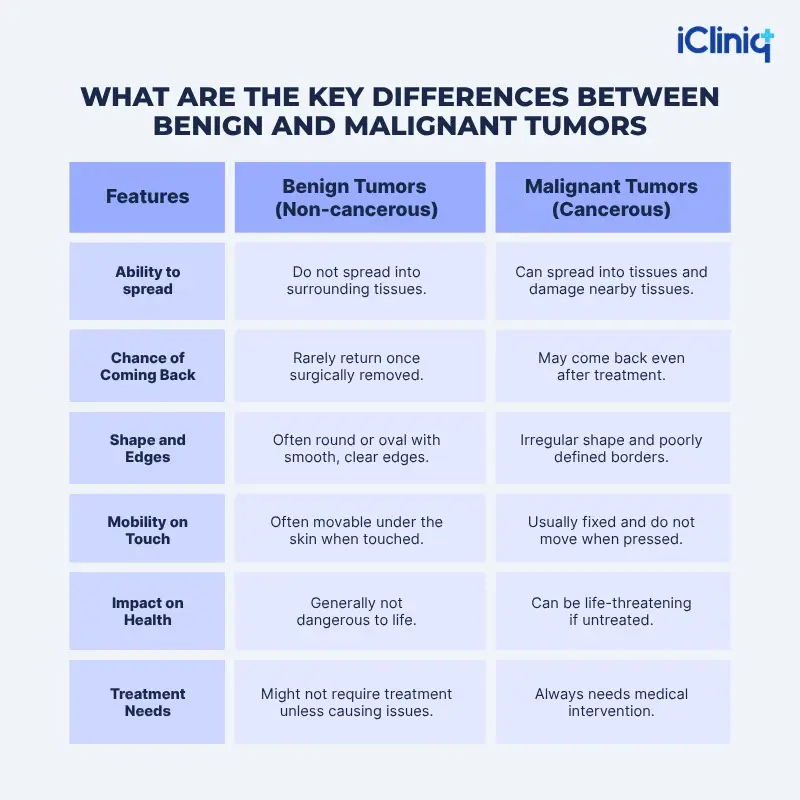
What Are the Key Differences Between Benign and Malignant Tumors?
The major differences between benign and malignant tumors are:
Can a Benign Tumor Turn Cancerous Over Time?
Most benign tumors (non-malignant) stay harmless and do not turn into cancer. But in some cases, certain types can slowly change over time. These are called precancerous or premalignant tumors.
So, it is important to take proper treatment for benign tumors. Do not miss follow-ups for benign tumors, thinking that the tumor is not serious. Even though it is not cancer, it is important to have regular check-ups and keep an eye on it. While it is rare for a benign tumor to become cancerous, it can happen in some people. Sometimes, what looks like a harmless lump at first may grow or behave differently later and might be malignant. Catching those changes early makes a big difference. Always keep an eye on the tumor and follow your doctor's instructions without fail to avoid any complications in the future.
How Are Benign and Malignant Tumors Diagnosed?
Diagnosis of Benign Tumor
-
In most cases, benign (non-cancerous) tumors are diagnosed by chance, either during a regular check-up or when you are being tested for something else.
-
If your doctor thinks the growth looks benign, they might recommend a few more tests (like an X-ray, ultrasound, or magnetic resonance imaging) to get a better look.
-
To be completely sure it is not a cancer (malignant), they may also do a biopsy (tumor cells examined under a microscope). This helps confirm whether the tumor is truly benign.
Diagnosis of Malignant Tumor
-
As malignant tumors are dangerous (cancerous), a thorough diagnosis is necessary.
-
To assess the tumor's size and spread, doctors will use a variety of imaging tests.
-
They employ magnetic resonance imaging (MRI), computed tomography (CT), or positron emission tomography (PET) scans.
-
To confirm cancer, a biopsy is required (looking at the cells under a microscope).
-
Genetic or blood tests may be used occasionally. Finding tumor markers or mutations will be done by it.
-
The stage of the cancer is identified following the diagnosis. It will direct the course of treatment.
How Are Benign and Malignant Tumors Treated?
In most cases, managing benign tumors (non-malignant) is simple (no treatment is needed for some). Malignant tumors are more serious and treatable, especially when diagnosed early. With modern medicines, advanced treatments, and personalized care plans, doctors can manage even complex cancer cases. The most important step is not to panic, but to stay informed and follow through with medical advice.
Treatment for a Benign Tumor
-
Treatment depends on factors like the type of tumor and your symptoms.
-
You may not need treatment if the benign tumor (non-malignant) is not growing or causing problems.
-
In such cases, your doctor may suggest watchful waiting, which includes regular check-ups.
-
If changes are noticed, doctors may give medications (for pain or swelling).
-
In some cases, surgery will be done to remove the tumor if it is pressing on nearby tissues or organs.
Treatment for Malignant Tumor
Treating malignant tumors (cancer) depends on a few important things, like where the tumor started and if it has spread to other parts of the body. Doctors look at the reports and decide on the best treatment. Treating a malignant tumor involves the following steps:
-
Surgery (taking out the tumor).
-
Radiation therapy (using strong rays to kill cancer cells).
-
Chemotherapy (using special medicine to destroy cancer cells).
-
Targeted therapy (using medicine that attacks cancer cells without hurting healthy ones).
-
Immunotherapy (helping your own immune system fight the cancer by using medicines).
Doctors may use just one treatment or a mix of these, depending on what your body needs to get better.
Conclusion
We all know that getting a tumor diagnosis can be concerning and scary. But the good side is that not all tumors are harmful or malignant. Some may not even require treatment because they are benign. Always consult your physician or a healthcare professional if you need any help. The earlier you know what you are dealing with, the better your chances of managing it well.
Note from iCliniq
Cancer, the word itself, seems scary for everyone. Whenever we notice any abnormal growth in our body, it is the first thing that comes to mind. If you have any questions related to any issues in your body, always ask an expert. You are not alone, and it is important to seek the right help at the right time. For any queries, you can connect and speak with one of our trusted doctors on icliniq.com. Our iCliniq team is available 24/7 to listen, guide, care, and support you in every step of your health.

