- 1What Is Stage 2 Lung Cancer?
- 2What Is the Survival Rate of Stage 2 Lung Cancer?
- 3Stage 2 Lung Cancer Overview Table
- 4What Are the Stage 2 Lung Cancer Substages (2A vs. 2B)?
- 5What Are the Symptoms of Stage 2 Lung Cancer?
- 6What Are the Causes and Risk Factors of Stage 2 Lung Cancer?
- 7How is Stage 2 Lung Cancer Diagnosed?
- 8What Are the Treatment Options for Stage 2 Lung Cancer?
- 9Living With Stage 2 Lung Cancer
- 10When to See a Doctor?
- 11Conclusion
- 12Key Takeaways
What Is Stage 2 Lung Cancer?
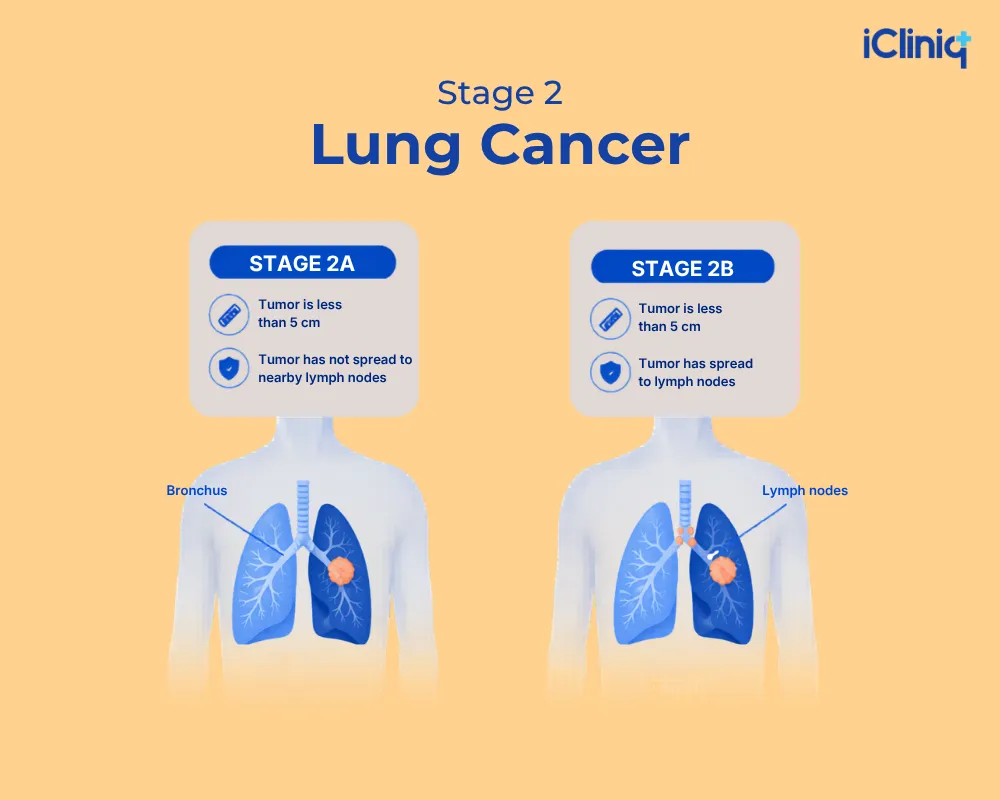
Stage 2 lung cancer is a localized and early-stage cancer. The size can be between 3 and 7 cm. At this point, your tumor has likely formed in or near your bronchi (those are the tubes bringing air into your lungs) and might be blocking some airways. The cancer may have also spread to nearby lymph nodes. While it's sometimes called locally advanced.
What Is the Survival Rate of Stage 2 Lung Cancer?
The National Cancer Institute reports that your five-year survival rate is 35 to 40 percent if you have stage 2 lung cancer and are getting treatment. It means that out of every 100 people who get treated for this type of cancer, about 35 of them will still survive for five years.
Stage 2 Lung Cancer Overview Table
|
Factor |
Details |
|
Stage |
Stage 2 (Early-stage cancer) |
|
Subtypes |
Stage 2A, Stage 2B |
|
Spread |
Nearby lymph nodes, not distant organs |
|
Symptoms |
Cough, chest pain, breathlessness |
|
Treatment |
Surgery + chemo/radiation |
|
Survival Rate |
~35-40% (5-year) |
|
Curability |
Often treatable and potentially curable |
What Are the Stage 2 Lung Cancer Substages (2A vs. 2B)?
In stage 2 lung cancer, there are 2 different substages based on where the cancer has traveled in your body: stage 2A and stage 2B.
Stage 2A: If you have stage 2A, your tumor is between 4 and 5 centimeters. Your lymph nodes are not getting involved. But the cancer could involve the bronchus or spread into the protective layer that covers your lung. Sometimes, part of your lung might collapse or get inflamed.
Stage 2B: Your tumor is bigger, between 5 and 7 centimeters. You might also have one or more additional tumors that have popped up in the same section of your lung. It has spread to your nearby lymph nodes.
With stage 2B, the cancer might have spread to some spots:
-
The protective layer around your heart
-
The inner lining of your chest wall
-
Your actual chest wall
-
The nerve that helps your diaphragm work
What Are the Symptoms of Stage 2 Lung Cancer?
In stage 2 lung cancer, you'll notice the stage 2 lung cancer symptoms that are as follows:
-
Coughing up bloody mucus.
-
You might also have a cough that just won't go away.
-
Chest pain.
-
You could find yourself dealing with lung infections more often than usual.
-
Weight loss.
-
Hoarseness of voice.
What Are the Causes and Risk Factors of Stage 2 Lung Cancer?
1. Main Causes to Watch Out For:
-
Smoking cigarettes.
-
Radon, a radioactive gas, is the second biggest cause.
-
If you work around asbestos, arsenic, chromium, nickel, beryllium, or cadmium, you're at higher risk.
-
Even if you don't smoke yourself, being around others who do can increase your chances.
-
Living in areas with heavy air pollution for years takes a toll on your lungs.
-
If you've had COPD (chronic obstructive lung disease) or tuberculosis (bacterial infection), the ongoing inflammation puts you at risk.
-
Sometimes it runs in families, so your genes might play a part.
2. Who's Most at Risk?
-
If you're over 65, your risk increases with age.
-
Women and non-smokers are seeing more in early-stage lung cancers (including stage 2).
-
High radon levels or areas with heavy industrial pollution indicate a higher risk.
-
Adenocarcinoma (one type of lung cancer) is often caught earlier, at stage 2.
How is Stage 2 Lung Cancer Diagnosed?
The diagnosis of stage 2 lung cancer is as follows:
Your doctor will do a physical exam to check you out. They'll want to know about your health history and if anything runs in your family.
Testing for Lung Cancer: If your doctor thinks cancer might be a concern, they might suggest it.
-
Biopsy: They'll remove a tiny piece of lung tissue for examination.
-
Sputum Test: Checking the mucus from your lungs under a microscope.
-
Imaging Scans: Pictures of your lungs using PET (positron emission tomography), MRI (magnetic resonance imaging), CT (computed tomography), or X-rays.
-
Bronchoscopy: A small tube is inserted to look for tumors (they might also grab a sample).
-
Thoracentesis: Testing the fluid around your lungs.
What Are the Treatment Options for Stage 2 Lung Cancer?
If you have stage 2 lung cancer, doctors aim to manage or treat the cancer . The treatments of stage 2 lung cancer are as follows:
1. Surgery:
-
If you're in good shape, surgery's usually your best bet.
-
You'll either have part of your lung removed (lobectomy, segmentectomy, or wedge resection) or the whole lung (pneumonectomy).
-
It all depends on where your tumor sits.
After Surgery: Once you've healed up, your doctor might suggest additional treatments to keep cancer from coming back. This could include chemo, immunotherapy, or targeted drugs.
2. Radiation Therapy:
Your doctor will give high-energy X-rays to kill any leftover cancer cells. You'll get this either from outside your body or from inside.
3. Drug Treatments:
-
You might need chemotherapy and immunotherapy for up to a year after surgery.
-
Immunotherapy works by blocking proteins that help cancer spread.
-
Sometimes radiation is used alone or mixed with chemotherapy.
4. Special Cases:
If you have a tumor bigger than 4 cm, you might get immunotherapy plus chemo before surgery. If tests show EGFR (epidermal growth factor receptor) gene mutations, you'll likely get targeted therapy based on genetic testing , which target the specific genes helping your cancer grow.
Living With Stage 2 Lung Cancer
When you're living with stage 2 lung cancer, you'll want to take charge with treatment that focuses on controlling the disease. Your main treatment includes surgery (usually a lobectomy), where they'll remove the tumor and those nearby lymph nodes. After that, you'll likely get some follow-up chemo or immunotherapy to help reduce the risk of recurrence.
When to See a Doctor?
If you're feeling off or notice symptoms that last for more than 3 weeks, it's time to talk with your doctor. They'll help figure out what's going on with your body.
-
Severe chest pain.
-
Persistent cough.
-
Recurring lung infections.
-
Swelling in your face, neck, or arms.
-
Dizziness.
-
Confusion.
-
Headaches.
-
Coughing up blood.
Conclusion
Stage 2 lung cancer means the cancer hasn't traveled beyond your lungs and has only reached the nearest lymph nodes. It has not spread to distant organs. Your cancer specialist may advise a treatment plan that will likely include surgery combined with chemotherapy, immunotherapy, targeted drugs, or radiation; sometimes you'll need a mix of these approaches. Finding a support group can help you navigate this journey; you don't have to face this alone.
Key Takeaways:
-
Stage 2 lung cancer is when your tumor has gotten bigger or reached nearby lymph nodes, but the good news is it's still hanging out in just one lung.
-
You might notice more symptoms compared to stage 1, but your doctors are still going for a cure, and they'll likely recommend removing the affected part of your lung through surgery.
-
Your treatment plan will include surgery first, then follow up with chemotherapy or immunotherapy.
-
With treatment, the chance of being disease-free at five years is around 35 to 40 percent, outcomes vary depending on individual factors when your cancer is caught at this stage.