- 1Why Does Tooth Replacement Matter?
- 2What Exactly Is a Dental Bridge?
- 3What Is a Dental Implant?
- 4Pros And Cons of Dental Bridge
- 5Drawbacks of Bridges
- 6Pros and Cons of Dental Implants
- 7How to Decide Between a Bridge and an Implant?
- 8What Are the Alternative Tooth Replacement Options to Bridges and Implants?
- 9Conclusion
- 10Key Takeaways
Why Does Tooth Replacement Matter?
Teeth serve a variety of purposes, including chewing, phonetics (speech), and maintaining the integrity of the jawbone and facial muscles. Gaps caused by missing teeth can eventually impact a person's personality and self-esteem, leading to emotional distress if they are not filled.
A person may lose one or more teeth due to gum disease or decay. The teeth may occasionally come out of the jaw due to a fall, an injury, or any other type of injury. Regardless of the reason for missing teeth, contemporary dentistry provides a number of efficient methods for their replacement.
What Exactly Is a Dental Bridge?
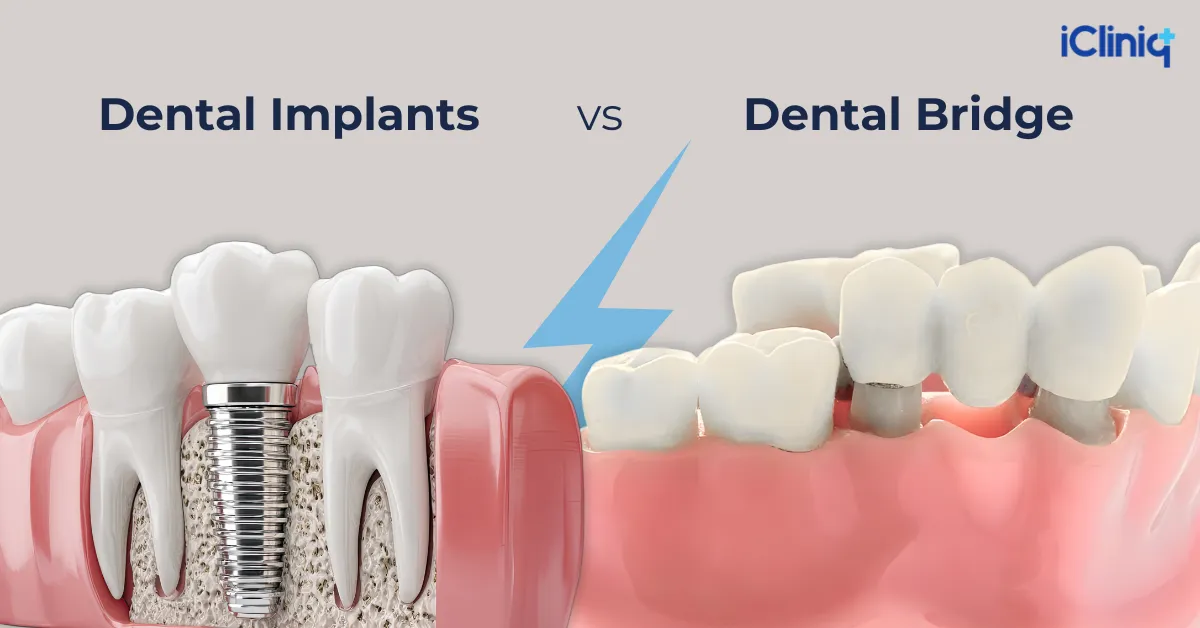
To replace lost teeth, dental bridges are utilized. They can replace a single tooth or a row of lost teeth. This device fills the gap in your smile, as the name suggests. Dentists can make custom bridges that match the color of your natural teeth.
A dental bridge is composed of various components:
-
Abutments: The structures that hold up your dental bridge are called abutments. Although the phrase is frequently used to describe natural teeth, it can also refer to the small connector posts found in bridges supported by dental implants.
-
Pontics: The artificial (false) teeth known as pontics are used to replace missing teeth.
Your bridge may have one or more abutments and one or more pontics, depending on your circumstances and the type of bridge you are given.
What Is a Dental Implant?
Small, threaded posts called dental implants are used to surgically replace lost teeth. Dental implants enhance your oral health in addition to filling in smile gaps. Implants function similarly to natural teeth once they heal.
Three components make up a dental implant:
-
Threaded Post: This can be compared to an artificial tooth root. During an oral surgery procedure, a doctor inserts it into your jawbone.
-
Abutment: The abutment is a small connector post. It protrudes just past your gums and screws into the threaded post. Your new artificial tooth is built on top of it.
-
Restoration: Any prosthetic that fixes or replaces teeth is referred to as a dental restoration. Crowns, bridges, and dentures are common dental implant restorations.
Pros And Cons of Dental Bridge
Benefits of Bridges
Dental bridges provide several advantages when it comes to rebuilding your smile:
-
Faster Process: Compared to dental implants, the process of placing a dental bridge is typically quicker. Following the implant post's placement in the mandible, it may take several months for the implant to heal before the crown is added. Conversely, bridges can frequently be finished in a few visits.
-
No Need for Surgery: Dental bridges are a non-surgical alternative to dental implants. Patients who are not good candidates for surgery or who would rather not have it can particularly benefit from this.
-
Cost: Compared to dental implants, dental bridges are frequently less expensive up front. Bridges often require less initial expenditure, but the long-term expenses may vary (bridges may need to be replaced after a specific number of years).
-
No Bone Grafting: Patients who have lost bone in their jaws may not be eligible for dental implants right away unless they receive bone grafting. Bone grafting is not a problem because dental bridges do not need the jawbone for stability.
-
Immediate Aesthetic Improvement: Compared to waiting for an implant to recover, patients can receive an improved aesthetic appearance more quickly by receiving a bridge.
-
Suitable for Specific Medical Conditions: Due to possible problems or slower healing, patients with specific medical conditions or those taking particular medications may not be the best candidates for implants. A bridge might be a better choice in certain situations.
Drawbacks of Bridges
However, bridges have certain disadvantages.
-
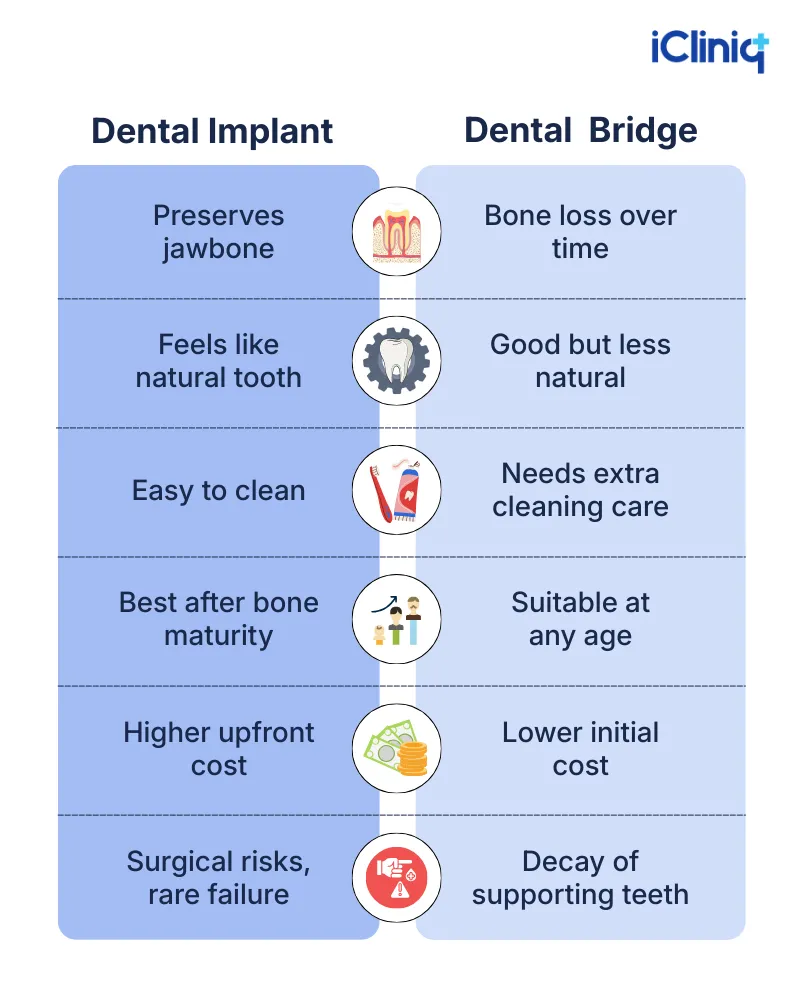
Impact on Adjacent Teeth: The teeth on either side of the gap must be prepared for the placement of a traditional dental bridge, which frequently necessitates the removal of a sizable portion of their enamel. These teeth may become weaker as a result, increasing their vulnerability to decay and other problems.
-
Durability: Depending on care and oral hygiene, dental bridges usually last between five and fifteen years. When maintained properly, dental implants can last a lifetime.
-
Bone Loss Prevention: By replacing the tooth root and stimulating the bone, dental implants aid in maintaining the jawbone and preventing bone loss. However, dental bridges do not offer this advantage, which may cause the jawbone to deteriorate over time.
-
Oral Hygiene Difficulties: Compared to natural teeth or dental implants, washing under and around a dental bridge may be more difficult. Gum disease and tooth decay in nearby teeth may become more likely as a result.
-
Natural Feel and Function: Because dental implants are firmly fixed in the jawbone, they often have a more natural feel and function. Even though they are useful, bridges may not feel as natural, particularly when biting or chewing.
-
Risk of Damage: If the bridge is not properly maintained, there is a chance that the teeth supporting it will deteriorate. The entire bridge may be impacted if one of the supporting teeth is weakened.
Pros and Cons of Dental Implants
Benefits of Implants
Dental bridges provide several advantages when it comes to rebuilding your smile:
-
Implants are the most durable alternative available and can endure for at least 15 years.
-
Implants keep their natural-looking appearance longer than bridges.
-
Avoid harming the healthy teeth surrounding the implant.
Drawbacks of Implants
However, bridges have certain disadvantages.
-
Less likely to have insurance coverage.
-
The procedure may take up to six months.
-
Greater initial expense.
-
Could result in surgical difficulties.
How to Decide Between a Bridge and an Implant?
The best choice for you will depend on your overall health, your budget, and the number of teeth you are missing.
-
Cost- An implant is less likely to be covered by dental insurance than a bridge. You might want to discuss partial dentures or other options with a dentist if you don't have insurance and both options are too costly.
-
Total Number of Teeth Lost- If you are missing multiple teeth in a row, a dental bridge is likely a better choice than an implant. For every lost tooth, a different implant must be surgically affixed to the jawbone, resulting in costly and frequently unfeasible surgery.
-
Overall Health - People with diseases like diabetes or leukemia that impede healing may not be able to get dental implants because they require surgery. The ideal candidates for dental implants have a healthy jawbone that can sustain the implant and are generally in good condition.
-
Time- A dental bridge can be installed in just two sessions with the dentist over a few weeks, whereas a dental implant can take months to complete. A surgeon will drill a hole in the jawbone to attach the implant's root to the bone. A temporary denture could be placed while you wait for the bone to recover. After that, it will take two to six months for the bone to recover before a crown can be placed.
What Are the Alternative Tooth Replacement Options to Bridges and Implants?
There are other ways to replace a lost tooth besides bridges and implants. Additionally, space maintainers and partial dentures may be utilized.
-
Partial or Complete Denture- Metal and plastic are typically used to make partial dentures. They cover the spaces left by one or more lost teeth. To stay in place, partial dentures generally mimic your natural teeth and clip to your healthy teeth. When the teeth surrounding a lost tooth are too weak to support a bridge, a dentist could suggest a denture. They are typically less sturdy and comfortable than bridges or implants, despite the fact that they are typically less expensive. They must be cleaned every day and may also make it difficult for you to eat or speak.
-
Flippers- Flippers, also known as temporary partial dentures, are quick-fix, lightweight, and reasonably priced partials that are frequently used as a stopgap measure while other treatments are underway.
Other Considerations Include:
-
Root Canal and Crown: A root canal treatment and crown can save a tooth that is injured but not lost, avoiding the need for a complete replacement.
-
Mini Dental Implants: More stable than dentures but less bone support than regular implants, these smaller, less costly implants are ideal for people with little bone or space.
Conclusion
As a permanent root replacement, choose a dental implant for longevity, bone health, and the preservation of neighboring teeth. However, be prepared for a greater initial cost and longer treatment period. If you need a quicker, less expensive upfront solution for one or more teeth, use a dental bridge; but, since it depends on nearby teeth, be ready for future replacements.
There are mainly two options to replace a missing tooth: bridges and dental implants. Dental bridges are less expensive up front and are more likely to be covered by your insurance. A dentist consultation is crucial since the ideal option relies on your long-term objectives, budget, and oral health. For personal advice, you can connect with a specialist.
Key Takeaways
-
The way your smile looks might be significantly affected by tooth loss. Dental bridges and implants are two popular methods used by dentists to treat these issues.
-
A dental implant is a titanium post that is surgically inserted in the jawbone to support a replacement tooth, whereas a dental bridge uses the neighboring teeth to hold a false tooth in place.
-
There is no one-size-fits-all solution when choosing between the two; rather, it is a very personal choice that is impacted by personal demands, dental health, budgetary constraints, and lifestyle choices.