Table of Contents
What Is a Hair Perm?
Do you enjoy adding waves or curls to your hair? Then a perm for hair might be a good choice for you. A perm is a chemical procedure that modifies the hair's internal structure to give it a particular shape, usually wavy. These chemical treatments cause your hair to curl or straighten. They are also referred to as permanent waves, permanent texture, or hair perms. Getting a hair perm can take several hours and last for three to six months. Your overall hair growth, hair treatment regimen, and scalp condition can all impact how long your perm lasts. Your perm will last longer if you have long hair than if you have short hair.
What Are the Types of Perms?
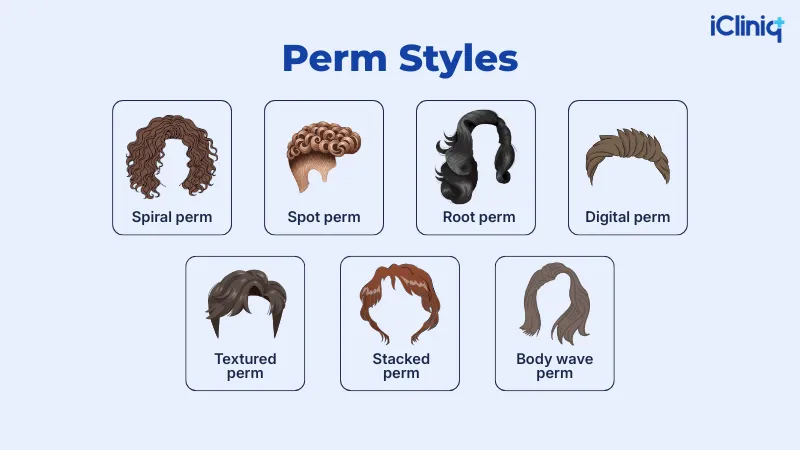
There are different perms based on the texture and the level of wave and volume you desire. These types of perms vary for different hair needs.
1. Body perm - This perm gives thin or flat hair more volume. It will also give you a light wave if your hair is straight.
2. Spot perm - This curl perm works on specific sections of your hair. It is good for people who want curls on the ends or in the middle. Spot perms create a more natural look.
3. Root perm - A root perm gives your hair more volume at the roots if you want it to have more body.
4. Spiral perm - This popular perm creates tight, bouncy curls.
5. Beach wave - This perm gives your hair loose curls and a fuller appearance.
6. Stacked perms - These curls are layered. For stacked perms, stylists use varying rod sizes on each layer of your hair.
7. Multi-textured perm - Your hairstylist will use various rod sizes throughout your hair to create a mix of looser and tighter waves for this perm. This creates a more natural wavy look.
8. Volume perm - People with thin hair can get this perm. It provides extra lift and volume.
9. Straight perm - Straight perms are designed to make naturally curly or wavy hair straight. Some people opt for a partial perm when they only want curls in specific areas.
Who Should Not Perm?
Perming can be a fantastic way to style your hair. However, it may not be suitable for all hair types. The suitability of natural hair for a perm depends on its texture and condition.
Perming can make curly hair appear frizzy. If your hair is weak or unhealthy, getting a perm can be particularly harmful. Avoid perming with:
1. Overly processed hair.
2. Hair with split ends.
3. Porous hair.
What Are the Benefits of Perming?
The following are the benefits of perming:
Long-lasting curls that look natural: It can be very difficult to have hair that lacks natural volume or root lift, but a perm can instantly change that. Even if you do not want to add curl, a perm can lift your roots and add volume.
You have a wide range of options for curl patterns these days that can give you a totally natural appearance. Soft spirals, beachy waves, tightly coiled ringlets, and everything in between are all possible. Only those closest to you will be able to tell that your curls came from a salon because they appear so natural.
Boosts volume: Those born with fine, limp hair understand the difficulty in achieving the volume necessary for certain hairstyles. Hair that lacks natural volume or root lift can be very tricky to manage.
However, a perm can change that immediately. A perm can lift your roots and add volume, even if you do not want any curls.
Time saver: Waking up with perfect curls every morning can reduce your beauty routine in half. This gives you more time to enjoy the things you love and helps you get out the door a bit faster.
What Are Risks and Potential Damage from Perms?
A perm is a chemical process that breaks the disulfide bonds in your hair fibers and then reforms them into a new curl pattern. Unlike temporary curling methods that use heat or rollers, a perm keeps its shape for several months without needing extra styling, even after washing, exercising, or swimming.
There are two main methods for perming: cold perms and hot perms. Cold perms are used more often than hot perms, although hot perms are gaining in popularity.
Combined risks and potential damage of cold and hot perms:
-
Cuticle damage.
-
Increased hair porosity, which can lead to dryness.
-
Skin irritation.
-
Allergic reaction.
-
Cell damage.
-
Immediate or delayed skin sensitivity.
-
Contact with carcinogens like aromatic amines.
-
Burns cause scarring alopecia (specific to hot perms).
Common Myths Versus Reality
Myth - Perms harm your hair.
Reality - The procedure chemically alters the hair's structure. However, it can be harmful if performed incorrectly or with improper aftercare.
Myth - Hair that is severely damaged or bleached can be permed.
Reality - To prevent serious breakage or "melting," a skilled stylist will probably decline to perm hair that is already severely bleached, extremely dry, or brittle. Good outcomes depend on having healthy hair.
How to Prepare Your Hair for a Perm?
Before getting the perm, it is essential to prepare your hair for the process. Preparation helps the perm set well and last longer. Here are some steps to prepare your hair:
-
Condition your hair: To strengthen your hair, deep condition it one week before the perm. Healthy hair holds curls better, and the chemicals used in perming are less likely to cause damage.
-
Avoid shampooing right before: There are good reasons not to wash your hair before a perm. Try to skip shampooing for at least 24 hours beforehand.
-
Stay away from heavy products: If you plan to have a perm, avoid using oils and serums beforehand. These products can interfere with the chemicals used in the perming process.
-
Assess hair health: For perms, healthy hair is ideal. Before getting a perm, consider treatments or trims if your hair is damaged or over-processed.
Proper perm hair care and perm aftercare help the curls last longer and keep the hair healthier. If you prepare well for this process, perming will be easier, and the chances of achieving long-lasting, defined curls will improve.
Conclusion
If you want to add long-lasting curls and volume to your hair, getting a perm is a good option. A perm, which stands for “permanent wave,” is a hair treatment that uses chemicals to curl or wave your hair for several months.
Some perms can last up to six months. To keep your perm looking great and to maintain your hair’s health, you will need to care for it differently from regular hair.
The most important rule for maintaining your perm is to let the curl set for the first 48 hours. During this time, refrain from touching or wetting your hair. For more information, connect with our dermatologist.
Key Takeaways
-
A perm changes your hair's structure to create curls or waves.
-
There are many perm styles, including beach wave perms and spiral perms.
-
Although a perm can give you lovely curls or waves, it can also cause significant damage.
-
Use the right haircare products to help reduce the damage a perm might cause.

