Table of Contents
Introduction
Psoriasis is complex! It appears in various forms, and each of them has its own unique symptoms, triggers, and level of severity. These different types help dermatologists choose the most suitable treatment for each patient.
Plaque psoriasis is the most common type, while erythrodermic and pustular psoriasis are rare and severe. Understanding these differences facilitates accurate diagnosis and personalized care. It is essential to determine the type of disease to understand its progression and provide the most effective management possible.
What Are the Types of Psoriasis?
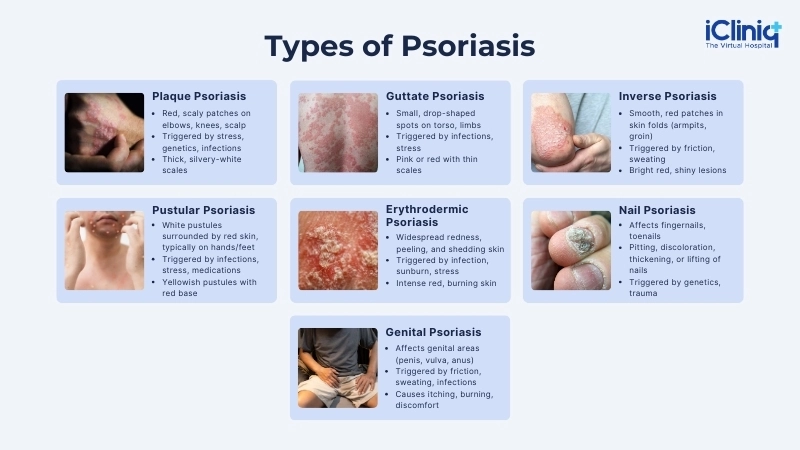
There are seven different types of psoriasis, and each has a unique pattern. These are listed as follows-
1. Plaque psoriasis or psoriasis vulgaris:
The plaque type of psoriasis is the most common and affects about 80 to 90 percent of the affected individuals. It appears as a red, elevated rash with a buildup of dead skin cells at the surface (plaques). These plaques can appear anywhere on the skin but are usually seen in the elbows, knees, scalp, lower back, or abdomen.
-
Plaque psoriasis on the face:
If psoriasis develops on your face, the discomfort is often exacerbated by its visible appearance. We know this can be painful and make you feel uncomfortable, but you are not alone in dealing with these sensitive areas. Common areas on the face where psoriasis may appear include the forehead, hairline, eyebrows, eyelids, and ears. Symptoms of facial plaque psoriasis include itchy scaling and inflammation around the face, which demands remedy.
-
Plaque psoriasis on the scalp:
Scalp psoriasis is a common site. It manifests as thick, silvery, scaly plaques that can extend down to the forehead, the back of the neck, and around the ears. Plaque psoriasis on your scalp may present as loosely adherent surfaces resembling dandruff. Psoriasis scabs on the scalp can be uncomfortable, causing itching, soreness, or burning, which may lead to hair loss.
2. Guttate psoriasis:
Guttate psoriasis is also known to affect young people, including children and adults. It frequently develops following a bacterial infection, such as strep throat. The lesions are small, red, and drop-shaped, where ‘guttate’ comes from, which translates as ‘drop-shaped.’ This is a rare form of psoriasis that develops as an abrupt disease.
3. Inverse psoriasis:
Inverse psoriasis occurs in areas with flexural creases, including the armpit, under the breast, groin area, and around the genitals. It is small, red, smooth, and shiny, without the thick scale characteristic of plaque psoriasis. Inverse psoriasis tends to affect skin folds, such as the armpits or groin area. Why? These areas are often damp, making friction and sweating a real nuisance for patients.
-
Inverse psoriasis of the groin:
Inverse psoriasis in the groin area can be easily confused with jock itch, as both conditions cause redness and inflammation in the same region. Nonetheless, inverse psoriasis is not accompanied by the fungal infection found in the case of jock itch.
-
Inverse psoriasis vs jock itch:
-
Inverse psoriasis: It is an autoimmune condition characterized by smooth, red patches in skin folds. It is treated with steroids or immune-modulating creams.
-
Jock itch: It is a fungal infection; it appears as a red, itchy, ring-shaped rash, and is treated with antifungals.
-
-
Shiny inverse psoriasis:
Inverse psoriasis looks smooth, glossy, and glistening because of constantly wet skin folds.
-
Inverse psoriasis odor:
Occasionally, inverse psoriasis in areas such as the groin may have an odor, as bacteria and moisture tend to accumulate.
-
Inner thigh inverse psoriasis:
This condition manifests as smooth, red, shiny areas of skin, most commonly in the inner thigh region where the skin rubs against itself. It can be a nuisance, causing pain or irritation, and exacerbated by sweating or rubbing.
-
Inverse psoriasis of the penis:
It is chiefly seen as red, smooth, shiny, and swollen areas in the penile skin with minimal scaling as the area is moist. It may lead to rashes, itchiness, or irritation, especially when engaging in sexual activity or urination.
4. Pustular psoriasis:
This is the least common form of psoriasis, manifested in white pustules with crimson-red areolas. Pustular psoriasis is confined to localized areas, the palms and soles, hence the name palmoplantar pustulosis, or generalized, involving large portions of the body called Von Zumbusch psoriasis. Signs include abscesses accompanied by pus, high body temperature, shivering, and the onset of skin itching.
-
Generalized pustular psoriasis (GPP) is a rare, severe variant of psoriasis characterized by the rapid development of widespread pustules on erythematous skin. While other types of psoriasis have specific localization patterns, GPP may involve any site and often occurs in large body regions. It is not infectious; an infection does not cause the pus in the blisters, but it deploys immune system dysfunction. Symptoms can include fever, chills, tiredness, muscle weakness, and tachycardia in the worst-case scenarios.
-
Acute generalized pustular psoriasis (von Zumbusch variant) is characterized by an eruption of millimeter-sized pustules with areas of surrounding erythematous, vesicular, or papular skin. Symptoms of acute GPP can include sore, swollen, and glowing red skin. Fluid loss through the skin can result in dehydration, especially when the skin is severely affected.
5. Erythrodermic psoriasis:
This is the rarest and most serious form of psoriasis. Think of it as a full-body shutdown; it affects the entire body, causing fiery red, scaly skin, severe pain, and fever. Immediate medical intervention is essential. This type can span the entire body and needs medical intervention since its complications include dehydration and infection.
Symptoms of early-stage mild erythrodermic psoriasis may include:
-
Large erythematous plaques involve areas, but not the entire area of a limb or an extensive zone of the trunk.
-
Skin with a burning sensation is often red or swollen, or the area feels hotter than the surrounding skin.
-
Hypersensitization is characterized by skin peeling or slightly scaling, itching, or discomfort.
-
Familiar inflammation of areas around the previous sites of involvement (for instance, patches in plaque psoriasis).
6. Nail psoriasis:
Nail psoriasis involves the nails and can manifest in pitting (small dimples), discoloration, thickening, and onycholysis - the separation of the nail from the nail bed. This form of psoriasis is commonly associated with other forms, particularly plaque psoriasis. Psoriasis in the nails does not cause pain, but abnormal-looking nails often pose discomfort to the patient. It is so severe that it may cause loss of nails or even damage them entirely.
Symptoms may include:
-
Pitting is when small indentations appear on the nails.
-
The presence of stain or yellow coloration.
-
Brittle or thickening of nails.
-
The condition where the nail has to be lifted from the nail bed.
7. Genital psoriasis:
Genital psoriasis is considered to be a type of psoriasis that develops on the genital skin, such as the penis and vulva, and nearby tissues. This type of psoriasis causes discomfort, irritation, and distress because it appears in a sensitive body area. Still, it is infrequent that patients mention it, but genital psoriasis can be as severe in terms of quality of life as other forms.
-
Genital psoriasis in women:
In women, genital psoriasis usually occurs in the vulval, perianal, and perineal regions. Predisposed skin areas can become inflamed, with red patches sometimes accompanied by scaling or dryness, due to psoriasis. Women may also develop extended manifestations, including itching, burning sensations, or pain in the genital area, more markedly during urine formation or during sexual activities.
-
Genital psoriasis in men:
In men, genital psoriasis can affect the genital area, characterized by thick, red, and shiny skin on the penis, scrotum, or the skin around the anus. It can manifest as red patches, scaling, or cracks that can be painful. For men, managing genital psoriasis carefully is crucial to avoid pain or stinging, particularly when urinating or during sexual activity. If you notice thick, red, or shiny skin in the genital area, talking to a dermatologist is the best next step. Male genital psoriasis may sometimes be confused with other skin conditions, such as fungal or contact dermatitis; therefore, it is advisable to consult a dermatologist for proper diagnosis and treatment.
-
Genital plaque psoriasis:
The most common form of psoriasis, plaque psoriasis, may also develop in the genital region. Genital plaque psoriasis manifests in plaques with raised red patches and silvery-white scales. However, because the skin in this body area is very sensitive, the plaques might present a different scale appearance than in other areas. Instead, they may appear smooth and red, although they can become irritated quickly when touched.
Conclusion
Psoriasis is a disease characterized by various patterns of inflammation and skin involvement; therefore, each type of psoriasis should be treated differently. Although plaque psoriasis is the most common type of the disease, special attention is to be paid to other types of psoriasis, including guttate, inverse, pustular, and erythrodermic, which have different manifestations and may result in serious complications. The determination of the exact subtype enables dermatologists to select specific therapeutic options, and it also provides patients with a better understanding of their condition, leading to improved disease control and quality of life.
Key Takeaway From iCliniq
-
This article describes the various forms of psoriasis, their respective features, severity, and management requirements.
-
Of all types, plaque psoriasis, which accounts for 80 to 90 percent of all cases, is the most common. Subtypes, such as pustular and erythrodermic psoriasis, are rare but may be severe if left untreated.
-
In cases of chronic skin scaling, reddening, and other conditions that deteriorate over time, a dermatologist should be consulted with the help of the iCliniq dermatology online consultation.

