Table of Contents
- 1What Is Stage 1 Endometrial Cancer?
- 2How Is Endometrial Cancer Staged and What Makes Stage 1 Different?
- 3Symptoms of Stage 1 Endometrial Cancer
- 4What Causes Endometrial Cancer and Who Is at Risk?
- 5How Is Stage 1 Endometrial Cancer Diagnosed?
- 6Stage 1 Endometrial Cancer Survival Rate and Prognosis
- 7When to Seek a Second Opinion About Stage 1 Endometrial Cancer
- 8Conclusion
What Is Stage 1 Endometrial Cancer?
Stage 1 endometrial cancer means the cancer has started in the lining of your uterus (called the endometrium). It has not spread to surrounding tissue. That matters enormously. When cancer stays where it starts, treatment is far more straightforward, and outcomes are much better. Most women diagnosed with endometrial cancer are caught at this stage. This helps in early, recognizable symptoms that prompt timely medical evaluation.
How Is Endometrial Cancer Staged and What Makes Stage 1 Different?
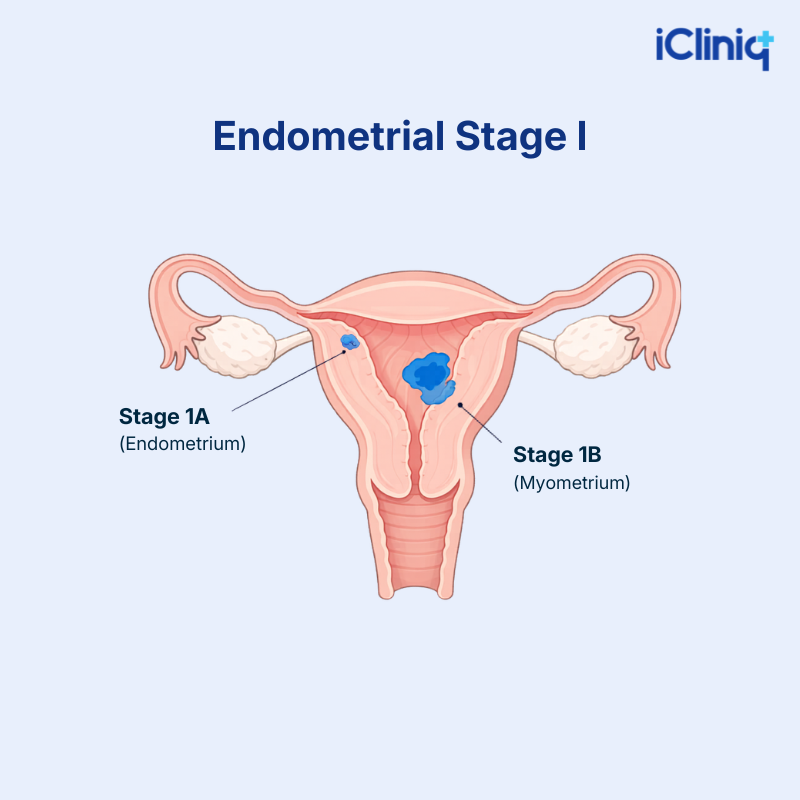
Staging means that your doctor can learn how far cancer has spread in your body. There are 4 stages of endometrial cancer. Each stage tells us how far cancer has spread in your body: from the uterus to the nearby tissues, to your lymph nodes, and then to your distant organs.
In stage 1, there are two stages.
-
Stage 1A.
-
Stage 1B.
The difference in stage 1A versus stage 1B endometrial cancer comes down to the depth of cancer invasion. In stage 1A, the tumor involves less than half the thickness of the muscle wall of the uterus, called the myometrium. In stage 1B, it's grown into more than half of that wall but still hasn't broken through. That distinction affects whether your doctor recommends radiation after surgery.
Symptoms of Stage 1 Endometrial Cancer
The most common stage 1 endometrial cancer symptoms are bleeding. If you've gone through menopause, any vaginal bleeding, including spotting, is considered abnormal. Postmenopausal bleeding is a strong warning indicator of endometrial cancer. This is the single biggest reason why many women are diagnosed at an early stage. Early diagnosis saves lives as treatment outcomes are better.
If you're still menstruating, watch for
-
Bleeding between periods.
-
Unusually heavy periods.
-
Bleeding after sex.
-
A watery or blood-tinged discharge.
-
Mild pelvic soreness, but pain is less prevalent.
What Causes Endometrial Cancer and Who Is at Risk?
When cells in the uterine lining proliferate uncontrollably, endometrial cancer results. Excess estrogen is the most common cause. The hormone that typically thickens your uterine lining every month. The lining tends to overgrow and eventually become malignant when the progesterone hormone isn't balanced with estrogen. The risk of endometrial cancer is commonly increased after menopause, with obesity, or with certain drugs.
Your risk is higher if you have the following conditions:
-
After menopause.
-
Unusual weight gain.
-
Have never been pregnant.
-
Taken drugs like Tamoxifen for breast cancer.
-
Polycystic ovary syndrome.
-
Family history of Lynch syndrome (an inherited condition linked to several cancers, including endometrial cancer)
All these conditions tend to raise your risk.
How Is Stage 1 Endometrial Cancer Diagnosed?
The initial step in diagnosing early-stage endometrial cancer is typically based on your symptoms. The typical symptoms particularly include irregular bleeding. Your doctor will likely ask you to perform the following tests:
-
Transvaginal Ultrasound: A transvaginal ultrasound utilizes a small probe to assess the thickness of your uterine lining. If the lining exceeds 4 to 5 mm (millimeters) following menopause, then it is worrisome. Additional examination is required.
-
Endometrial Biopsy: It involves the removal of a small piece of tissue from the lining of your uterus using a thin tube. This takes only a few minutes and is done in the clinic. It gives your doctor the most accurate picture.
-
Hysteroscopy: If the biopsy results are not clear, your doctor may recommend hysteroscopy. This process involves placing a camera directly into the uterus. This procedure is done along with a D&C (dilation and curettage) to get more tissue.
Stage 1 Endometrial Cancer Treatment Options
-
Hysterectomy Surgery: The most preferred option for stage 1 endometrial cancer is surgery. The standard procedure is a hysterectomy, where the uterus and cervix are removed. Most surgeons also remove the ovaries and fallopian tubes, since they produce estrogen and can be a site of spread. This is called a total hysterectomy with bilateral salpingo-oophorectomy. Your surgeon will explain what that means for you specifically.
-
Hysterectomy by Laproscopy or Robotic Techniques: The latest advancement in medical surgery involves minimally invasive surgeries. Today, most endometrial cancer hysterectomies are performed using minimally invasive robotic or laparoscopic techniques. You will recover faster, have fewer incisions, and spend less time in the hospital than you would with open surgery.
-
Vaginal Brachytherapy: For stage 1A with low-grade tumors, surgery alone is often enough. Stage 1B or higher-grade tumors may mean your oncologist recommends vaginal brachytherapy, a targeted form of radiation delivered directly to the vaginal vault to lower the chance of cancer coming back locally.
-
Endometrial Cancer Fertility-Sparing Options: These options exist for younger women who haven't completed their families. If your tumor is low-grade, confined to the endometrium, and you've been thoroughly counseled about the risks, high-dose progesterone therapy can shrink the cancer temporarily. But this isn't a permanent solution. Most specialists recommend completing surgery once your family is complete. You'll need very close monitoring throughout.
Stage 1 Endometrial Cancer Survival Rate and Prognosis
The numbers here are genuinely reassuring. The endometrial cancer stage 1 survival rate at five years is around 90% or above for stage 1A and approximately 80 to 85% for stage 1B. These figures reflect women treated with surgery, with or without radiation. Stage 1 uterine cancer prognosis also depends on tumor grade, how aggressive the cells look under a microscope, and the specific cell type. Grade 1 and 2 tumors behave more slowly and respond well to treatment. Grade 3 tumors are more aggressive and carry a higher recurrence risk, even at stage 1. Your oncologist will use grade, stage, substage, and cell type together to give you the most accurate picture of your individual outlook.
Reducing the Risk of Recurrence After Stage 1 Treatment
Endometrial cancer recurrence after treatment happens in roughly 5 to 15% of stage 1 cases, most often within the first three years. So your follow-up schedule matters. Most oncologists see patients every three to four months for the first two to three years, then every six months after that. You can also lower your recurrence risk through lifestyle. Regular exercise has been associated with improved outcomes for endometrial cancer survivors, and maintaining a healthy weight lowers circulating estrogen levels.
When to Seek a Second Opinion About Stage 1 Endometrial Cancer
A second opinion isn't a sign that you don't trust your doctor. It's standard practice for cancer diagnoses, and most oncologists expect it. Seek one if you're uncertain about whether you need radiation after surgery, if you're young and want to explore fertility-sparing approaches more thoroughly, or if your tumor has unusual features like a rare cell type. Academic medical centers and NCI (National Cancer Institute)-designated cancer centers have dedicated gynecologic oncology teams who handle high volumes of these cases. That experience matters when you're facing a close call on treatment decisions.
Conclusion
Stage 1 endometrial cancer is serious, but it's also one of the most treatable cancers, as the cancer remains confined to the uterus. The treatment mainly depends on how early it is identified. Surgery gives most women a complete cure. And even with the addition of radiation, it’s short and targeted. Knowing your specific grade and substage is important, as is consistency in your follow-up care. Still not sure? Our medical professionals are here to help. Consult a cancer specialist who can properly evaluate what's going on.
Key Takeaways
-
Depending on the grade and substage, the five-year survival rate for stage 1 endometrial cancer. In stage 1 the cancer is limited to the uterus.
-
Postmenopausal bleeding is the key early warning sign. Any bleeding after menopause needs prompt evaluation.
-
Surgery, usually a minimally invasive hysterectomy, is the primary treatment; radiation is added selectively based on grade and substage.