
- 1What Is Stage 1 Lung Cancer?
- 2Stage 1 Lung Cancer Overview Table
- 3Stage 1 Lung Cancer Substages
- 4What Are the Symptoms of Stage 1 Lung Cancer?
- 5What Are the Causes and Risk Factors?
- 6How Is Stage 1 Lung Cancer Diagnosed?
- 7What Are the Treatment Options for Stage 1 Lung Cancer?
- 8What Is the Prognosis for Stage 1 Lung Cancer?
- 9Living With Stage 1 Lung Cancer
- 10When to See a Doctor?
- 11Conclusion
- 12Key Takeaways:
What Is Stage 1 Lung Cancer?
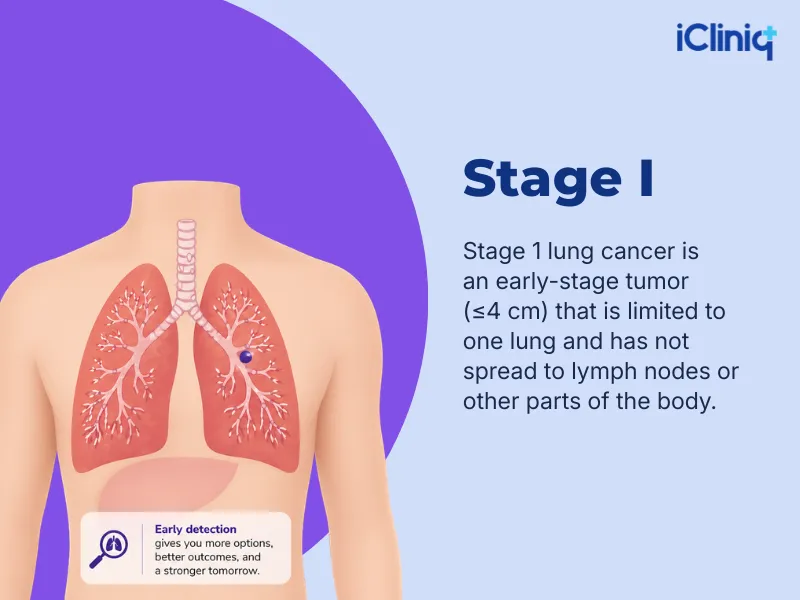
Stage 1 lung cancer is the first stage of lung cancer. It is frequently referred to as localized lung cancer or early-stage lung cancer. Stage 1 lung cancer is characterized by a 4 cm tumor in one lung that has not spread to other organs or lymph nodes.
Survival Rate of Stage 1 Lung Cancer
Stage 1 lung cancer usually has a good prognosis compared to other stages. Overall, the survival rate for stage 1 lung cancer is estimated to be about 60 to 90%. About 70 to 90% of people diagnosed at this early stage live for at least 5 years or longer after diagnosis.
Five-Year Survival Rate by Age for Stage 1 Lung Cancer:
-
Under 50 years: Approximately 83.7 %.
-
50 to 64 years: Approximately 67.4%.
-
65 years and older: Approximately 54.6%.
Stage 1 Lung Cancer Overview Table
|
Factor |
Details |
|
Stage Definition |
Cancer is confined to the lung, with no lymph node spread. |
|
Tumor Size |
Up to ~4 cm. |
|
Symptoms |
Mild or none (cough, chest pain, breathlessness). |
|
Diagnosis |
CT scan, biopsy. |
|
Treatment |
Surgery, radiation, targeted therapy. |
|
Survival Rate |
~60-90% (5-year). |
|
Cure Chances |
High if detected early. |
Stage 1 Lung Cancer Substages
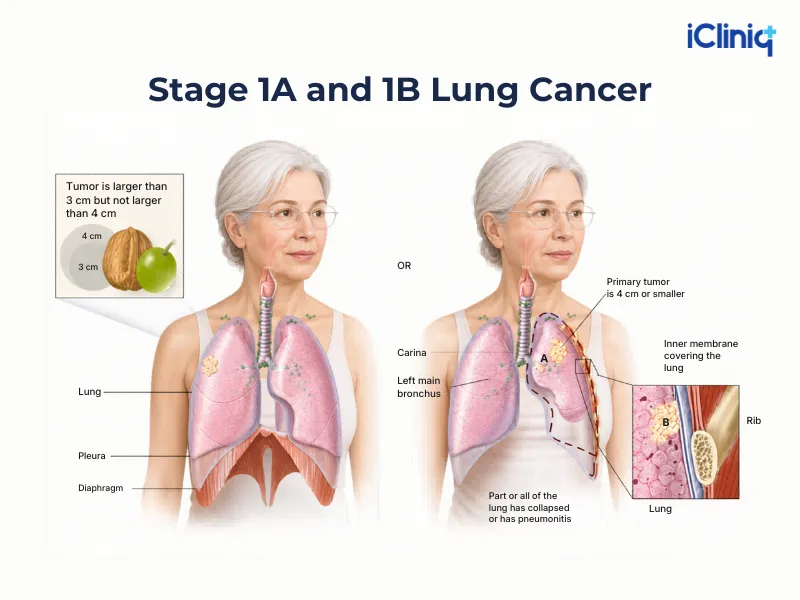
Stage 1 lung cancer is divided into two stages: stage 1A and stage 1B.
Stage 1A Lung Cancer:
-
The tumor measures between 1 cm and 3 cm.
-
The cancer is limited to the lung.
-
No spread to nearby lymph nodes.
-
There is no spread to distant parts of the body.
Stage 1B Lung Cancer:
-
The tumor measures 3-4 cm.
-
The cancer may have grown into the main airway (bronchus) of the lung.
-
The cancer may have spread to the visceral pleura, the thin lining that covers the lung.
-
The tumor may block the airway or cause inflammation, which can lead to partial or complete collapse of part of the lung.
What Are the Symptoms of Stage 1 Lung Cancer?
Stage 1 lung cancers do not have any obvious symptoms. They are frequently identified during regular health screenings. In stage 1 lung cancer, the symptoms can be minor and easily missed.
However, some individuals might notice the following symptoms:
-
A new cough that does not go away.
-
A long-standing cough that worsens over time.
-
Coughing up blood or blood-stained mucus.
-
Shortness of breath or difficulty breathing.
-
Persistent chest discomfort or pain.
-
Repeated lung infections (bronchitis or pneumonia).
-
Unexplained weight loss.
Since these symptoms can be associated with various other conditions, people with risk factors for lung cancer should do regular medical evaluations and screenings for early identification.
What Are the Causes and Risk Factors?
The causes of stage 1 lung cancer can vary widely from person to person. Some of the main contributing causes and risk factors include:
-
Smoking: Tobacco use is the leading cause of lung cancer. The toxic compounds found in cigarette smoke can damage lung cells and cause alterations that may eventually lead to cancer.
-
Secondhand Smoke: People who do not smoke can still face an increased risk of lung cancer if they are regularly exposed to smoke from others over a prolonged period.
-
Genetic Factors: A familial history of lung cancer may heighten the likelihood of developing the disease.
-
Occupational Exposure: People working in settings that contain harmful substances like arsenic, chromium, or diesel fumes face an increased risk of lung cancer due to their ongoing exposure.
How Is Stage 1 Lung Cancer Diagnosed?
Stage 1 lung cancer is usually diagnosed through a combination of imaging tests and laboratory procedures that help doctors confirm the presence of cancer and determine how far it has spread. As the stage 1 lung cancer symptoms may be mild or absent in the early stage, the condition is often detected during routine screening or evaluation for another health issue.
The common tests are the following:
-
Low-Dose CT Scan (LDCT): The most effective screening test for detecting early lung cancer, especially in people at high risk.
-
Chest X-ray: Often the first imaging test used to identify abnormal spots or masses in the lungs.
-
CT (Computed Tomography) Scan: It provides detailed images of the lungs to assess the tumor's shape, size, and location.
-
PET Scan: A positron emission tomography scan determines whether the cancer has spread to other parts of the body.
-
Biopsy: A small sample of lung tissue is removed and examined to confirm the diagnosis.
-
Bronchoscopy: A slender, pliable tube equipped with a camera is introduced through the mouth or nose to examine the airways and, if necessary, collect tissue samples.
What Are the Treatment Options for Stage 1 Lung Cancer?
Treatment for stage 1 lung cancer involves surgery to remove the tumor. In certain situations, doctors may also recommend targeted therapy, chemotherapy, or radiation therapy, especially if surgery is not possible or if there is a higher risk that the cancer could return.
Types of Surgery for Stage 1 Lung Cancer
-
Lobectomy: The surgeon removes the entire lobe of the lung that contains the tumor. This is the most common and preferred surgery for stage 1 lung cancer.
-
Segmentectomy (Segmental Resection): Only a small section (segment) of the lung lobe is removed instead of the whole lobe. This may be done when preserving lung function is important.
-
Sleeve Resection (Sleeve Lobectomy): The surgeon removes the affected lung lobe along with a portion of the main airway (bronchus), then reconnects the remaining airway to healthy lung tissue.
Other Treatment Options
-
Targeted Therapy: Uses special medicines that attack specific cancer cells based on their genetic features. It may be given after surgery in selected patients.
-
Radiation Therapy: In this, high-energy rays are used to destroy cancer cells. A precise method called stereotactic body radiation therapy (SBRT) may be recommended for people who cannot undergo surgery.
-
Chemotherapy: Anti-cancer drugs may be used after surgery in certain cases, especially if there is a higher risk of the cancer coming back.
What Is the Prognosis for Stage 1 Lung Cancer?
Stage 1 lung cancer has a good prognosis, especially when it is found early. Many patients live for several years after treatment, and survival rates are much higher than for later stages. Factors that affect the outlook include the patient’s age, overall health, tumor type, and treatment response.
Living With Stage 1 Lung Cancer
If you are living with stage 1 lung cancer, then you need regular follow-ups and healthy lifestyle choices that support recovery and overall well-being. Here are some important steps to consider:
-
Take follow-up appointments regularly.
-
If you are a smoker, then stop it.
-
Eat a balanced and nutritious diet.
-
Stay physically active as advised by a doctor.
-
Seek emotional and social support whenever you need it.
When to See a Doctor?
Consult a doctor if you notice any of the symptoms:
-
A cough lasting more than three weeks.
-
Chest pain that does not improve.
-
Shortness of breath or wheezing.
-
Unexplained weight loss.
-
Coughing up blood.
-
Persistent fatigue or repeated lung infections.
Early medical evaluation can lead to earlier diagnosis and better treatment outcomes.
Conclusion
Stage I lung cancer is treatable if addressed early, and it has very high survival rates. Understanding the risk factors, symptoms, and available treatments is crucial for minimizing the impact of the disease in its early stages. The tumor is still confined to the lung in stage 1 lung cancer. Survival rates can be impacted by variables like age, overall health, and smoking history. Pay attention to any unusual symptoms you have. If you have breathing issues, a long-standing cough despite treatment, or chest pain, seek advice from a lung specialist early for proper treatment.
Key Takeaways:
- Stage 1 lung cancer is an early-stage disease. The tumor is limited to the lung and has not spread to distant organs.
- Early detection greatly improves survival, with many patients living for 5 years or more after treatment.
- Regular screening is needed for people at higher risk, especially smokers, those with occupational exposure, and older adults.
- Surgical procedures such as lobectomy, segmentectomy, and sleeve resection are the most common procedures that treat Stage 1 lung cancer, though at times radiotherapy, targeted therapy, or chemotherapy may be administered.
