
- 1What Is Cyclobenzaprine?
- 2How Does Cyclobenzaprine Work? (Mechanism of Action)
- 3When Is Cyclobenzaprine Prescribed?
- 4How Should You Take Cyclobenzaprine? (Dosage & Administration)
- 5How Often Should Cyclobenzaprine Be Taken?
- 6What Should You Know About Missed Doses and Overdoses?
- 7What Are the Side Effects of Cyclobenzaprine?
- 8What Warnings and Contraindications Should You Know About?
- 9Can Cyclobenzaprine Be Used in Special Populations?
- 10Can Pregnant or Breastfeeding Individuals Use Cyclobenzaprine?
- 11Is Cyclobenzaprine Appropriate for Children?
- 12Conclusion
- 13Key Takeaway
What Is Cyclobenzaprine?
A drug called Cyclobenzaprine relaxes your muscles and lessens stiffness. It also relieves muscle spasms. This medication can be taken orally with water. After taking this medication, you might feel sleepy or lightheaded. This medication, however, is not an alternative for physical therapy, exercise, rest, or any other treatment your doctor may recommend for your condition.
Cyclobenzaprine affects the signals that pass through the nervous system and stimulate muscle contractions. The medication is normally prescribed for a short time, which can last for a number of weeks. You should not consume alcohol when using the medication since it can induce drowsiness.
How Does Cyclobenzaprine Work? (Mechanism of Action)
Cyclobenzaprine is a muscle relaxant with central action. This indicates that rather than acting directly on skeletal muscles, its main site of action is the central nervous system (CNS). It is generally recognized that Cyclobenzaprine exerts its muscle-relaxing effect through action on the brainstem.
The brainstem represents an integral part of the central nervous system, and it monitors motor function, as well as controls muscle tone. It is understood that Cyclobenzaprine decreases muscle hyperactivity through inhibition of nerve impulse transmission at the brainstem. Muscle stiffness and discomfort are relieved as a result of this inhibition, which also reduces muscle spasms.
When Is Cyclobenzaprine Prescribed?
Cyclobenzaprine is widely used to treat muscular spasms caused by an accident or other condition that causes muscle or joint pain. Cyclobenzaprine may also be used to treat other conditions as determined by your physician.
How Should You Take Cyclobenzaprine? (Dosage & Administration)
Dosage Forms
-
The initial dose (days 1 to 14) is 2.8 mg (one sublingual tablet) taken once daily at bedtime.
-
Maintenance dose (days 15 and up): 5.6 mg (two sublingual tablets) once daily at bedtime.
-
The maximum suggested dose is 5.6 mg once daily.
-
Dose modification: For senior patients and those with mild hepatic impairment, the suggested maximum dose is 2.8 mg (one sublingual tablet) once daily at bedtime.
-
It is not indicated for patients with moderate to severe hepatic impairment.
Adult Dosage
For oral dosing (extended-release capsules): Adults use 15 milligrams (mg) once each day. Some people may require 30 mg (one 30 mg capsule or two 15 mg capsules) each day.
How Often Should Cyclobenzaprine Be Taken?
Cyclobenzaprine is generally intended for short-term use, usually for two to three weeks. Cyclobenzaprine administration frequency is dictated by the medication's exact formulation and the disease being treated.
The normal routine for managing muscular spasms is the following:
-
Immediate-Release (IR) Tablets: These are frequently prescribed for several daily administrations.
-
Extended-Release (ER) Capsules: Take once daily, preferably at the same time every day.
-
Sublingual Tablets: One brand of this formulation is normally given once daily at bedtime to treat fibromyalgia.
What Should You Know About Missed Doses and Overdoses?
Missed Dose:
If you miss a dose of this medicine, take it as soon as possible. However, if it is almost time for the next dose, skip the missed dose and follow the usual dosing schedule. Do not double doses. If you miss a dose of the sublingual tablet, take your next dose at the time you usually take it. Do not take a double dose to make up for a missed one.
Overdose
Seek immediate medical attention if you or someone else has taken too much Cyclobenzaprine.
Overdose symptoms could include the following:
-
Sleepiness.
-
Rapid or erratic heartbeat.
-
Feeling confused and agitated.
-
Difficulty moving or speaking.
-
Nausea.
-
Vomiting, hallucinations (hearing voices or seeing things that do not exist).
-
Unconsciousness.
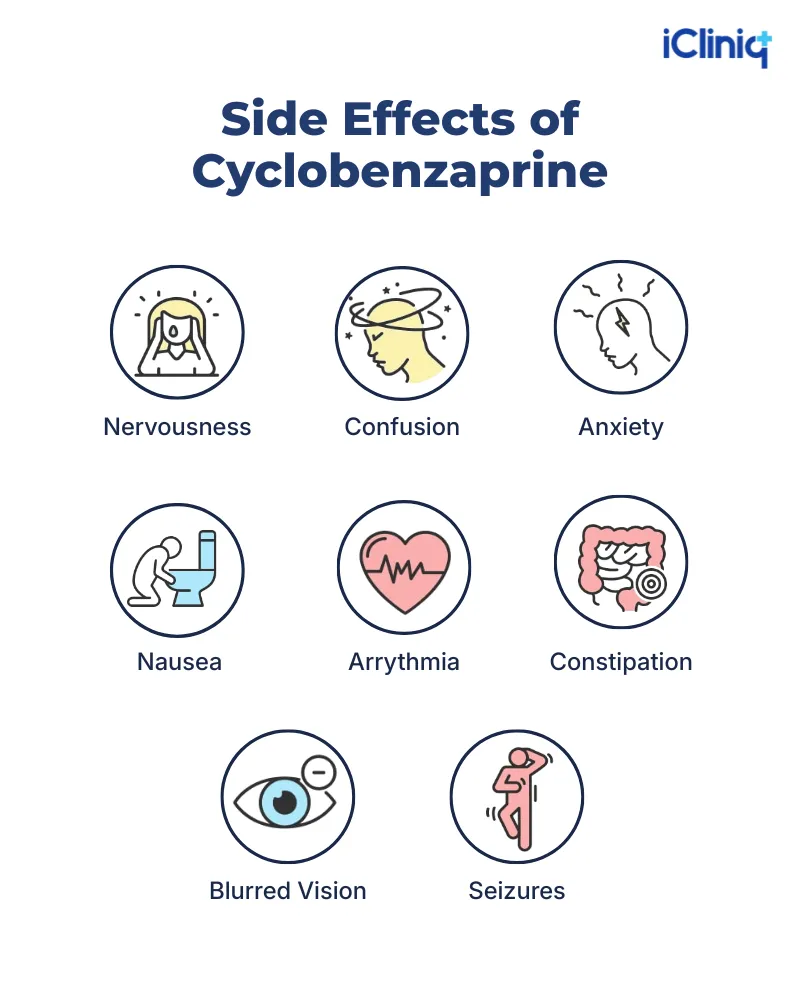
What Are the Side Effects of Cyclobenzaprine?
Common Side Effects
-
Dry mouth or throat.
-
Excitement or nervousness.
-
Numbness, tingling, discomfort, or pain in your mouth, teeth, or tongue.
-
Sleeplessness.
-
Unusual muscle weakness.
Serious Side Effects
-
Anxiety (feeling of unease).
-
Black, tarry stools.
-
Blurred vision.
-
Chest pain, discomfort, or tightness.
-
Chills.
-
Clumsiness or unsteadiness.
-
Confusion.
-
Dark urine.
-
Difficulty moving, difficulty swallowing.
What Warnings and Contraindications Should You Know About?
Do not use Cyclobenzaprine in any of the following conditions:
-
Heart Conditions: Acute stage of heart attack, heart failure, heart block, and arrhythmias (irregular rhythm).
-
Hyperthyroidism: A condition in which the thyroid gland is overactive.
-
MAO Inhibitors: Concomitant use or use of an MAOI (monoamine oxidase inhibitors) within the past 14 days due to the risk of fatal interaction.
-
Hypersensitivity: Any known allergy to Cyclobenzaprine or any of its ingredients.
Cyclobenzaprine Drug Interactions
Cyclobenzaprine may interact with the following:
-
Alcohol.
-
Bupropion.
-
Antihistamines for allergy, cough, and cold.
-
Anxiety or sleep medicines, including certain drugs.
-
Certain medications are used for bladder problems, such as Oxybutynin and Tolterodine.
-
Certain antidepressants, for example, Amitriptyline, Fluoxetine, and Sertraline.
-
Certain medications used to treat Parkinson's disease (a neurological disorder), such as Benztropine, Trihexyphenidyl.
-
Certain anticonvulsant drugs, including Phenobarbital, Primidone.
-
Certain drugs for the stomach, including Dicyclomine, Hyoscyamine.
Can Cyclobenzaprine Be Used in Special Populations?
-
Is Cyclobenzaprine Safe for Older Adults?
For persons 65 years of age and older, Cyclobenzaprine is typically regarded as potentially inappropriate. Due to an unfavorable risk-benefit ratio, older folks should generally avoid.
-
Increased Fall Risk: Because of the sedative and dizzy-inducing nature of this medication, the elderly population is at an increased risk for falls and fractures.
-
Cognitive Impairment: It may induce confusion, hallucinations, and delirium in senior citizens.
-
Anticholinergic Side Effects: Because it is related in structure to other antidepressant medications, it often results in dry mouth, constipation (difficulty in passing stool), and urinary retention.
-
Drug Build-Up: Elderly individuals usually have a lesser ability to metabolize the drug in the liver and kidneys. This causes a build-up of the drug in the blood and a longer elimination half-life.
Can Pregnant or Breastfeeding Individuals Use Cyclobenzaprine?
-
Safety Profile: As it is often classified under FDA Pregnancy Category B, there are not sufficient studies carried out among humans, although the studies conducted on animals did not show any harm to the fetus.
-
Risks During the First Trimester: As stated in some recent research, drugs during conception or the first trimester might cause congenital problems like heart or orofacial abnormalities.
-
Third Trimester Risks: Late use during pregnancy can lead to distress for the fetus, which may include irritability and, as reported by some clinical observations, an early closure of the fetus's life-sustaining blood vessel, the ductus arteriosus.
-
Medical Advice: If it is necessary to counteract the disadvantages faced by pregnant women, you must consult a medical practitioner.
Is Cyclobenzaprine Appropriate for Children?
Cyclobenzaprine is a muscle relaxer. It is mainly prescribed to relieve muscle spasms. However, the drug is safe and effective in children under certain age restrictions:
-
Cyclobenzaprine is also approved for adolescents over 15 years of age. For older adolescents, the usual dose is 5 mg to 10 mg three times daily.
-
There are no established precautions for use in children under the age of 15 years; it is not prescribed for children by physicians, and it has not been authorized by the FDA (Food and Drug Administration) for use in such children.
Conclusion
Cyclobenzaprine oral tablet belongs to a generic class of drugs that are indicated for the treatment of muscle spasms associated with painful muscle conditions lasting only for a short term. Cyclobenzaprine oral tablet is indicated to relax the muscles. It works by relieving pain, stiffness, or discomfort associated with strains or injuries to your muscles. It is given along with rest and exercises. You might experience drowsiness or dizziness after consuming the drug. For more details, you can consult a specialist.
Key Takeaway
-
Cyclobenzaprine is indicated for the short-term treatment of muscle spasms associated with acute muscle injury.
-
It affects the central nervous system to relax the muscle spasms, rather than directly relaxing the muscles.
-
Drowsiness and dry mouth are the possible side effects.
-
It is meant for short-term use only and should always be used in combination with rest and physiotherapy.