- 1What Is Ferrous Sulfate?
- 2What Is Ferrous Sulfate Used For?
- 3When Should You Take Ferrous Sulfate?
- 4How Does Ferrous Sulfate Work? (Mechanism of Action)
- 5Dosage and Administration
- 6What Should You Know About Missed Doses and Overdose Risks?
- 7What Are the Side Effects of Ferrous Sulfate?
- 8Warnings and Precautions
- 9What Interactions Can Occur With Ferrous Sulfate?
- 10Ferrous Sulfate Use During Pregnancy And Breastfeeding
- 11How Should You Store Ferrous Sulfate?
- 12Key Takeaways
What Is Ferrous Sulfate?
Ferrous sulfate is an iron supplement that helps treat or prevent anemia (lack of iron). Red blood cells help carry oxygen in your body. Iron is an element in your body that helps you produce red blood cells. Some people, such as those with heavy bleeding, pregnancy, or a lack of iron in their food, may have low iron in their bodies and become anemic.
What Is Ferrous Sulfate Used For?
Ferrous sulfate is considered an effective iron supplement because of its good absorption rate. The main indications for Ferrous sulfate are:
-
Treatment and prevention of iron deficiency anemia: Iron deficiency anemia can be described as a situation where an individual lacks red blood cells or hemoglobin in their body. Ferrous sulfate is the most widely used indication.
-
Pregnancy: Iron intake can be higher during pregnancy, and pregnant women usually require supplements to prevent iron deficiency.
-
Restless legs syndrome (RLS): Ferrous sulfate is sometimes used in the treatment of RLS, especially in children.
-
Enhancing surgical outcomes: Pre-operative iron deficiency correction may have a potential role in lowering post-operative complication risk and shortening hospital length of stay.
When Should You Take Ferrous Sulfate?
You should ideally take Ferrous sulfate on an empty stomach, or you can take it at least one hour before or two hours after you eat a meal. You must take it for several months to treat iron deficiency anemia. For as long as you are at risk of developing iron deficiency anemia, you must take Ferrous sulfate.
To increase your body's supply of iron, your doctor will typically recommend continuing for three to six months after your condition has improved.
How Does Ferrous Sulfate Work? (Mechanism of Action)
In particular, iron is necessary for the production of red blood cells (RBC), which carry oxygen throughout the body. The body cannot produce sufficient healthy red blood cells when iron levels are low. When the body's iron reserves fall to extremely low levels, there is not enough iron available for normal red blood cell production, leading to iron deficiency anemia.
Insufficient dietary iron, trouble absorbing iron, bleeding, pregnancy, or losing iron through urine can all cause iron deficiency. Symptoms include fatigue, shortness of breath, palpitations, dizziness, and headaches.
Iron, a necessary component of hemoglobin, myoglobin, and numerous enzymes, is restored by ferrous sulfate. Hemoglobin, an essential protein required for the transport of oxygen from the lungs to other tissues, is formed when iron combines with porphyrin and globin chains.
Ferrous sulfate works by raising your body's iron levels, which causes hemoglobin and myoglobin to form and enable the transportation of oxygen where it is needed.
Dosage and Administration
How should you take Ferrous sulfate?
-
If using a tablet form, swallow the tablet whole. Do not crush, chew, or break it. If you are using a liquid form, then measure your medicine carefully. Use a dosing syringe.
-
You should not take iron supplements together with milk, caffeine, antacids, or calcium supplements.
-
Try to take your iron supplement with vitamin C-for example, a glass of orange juice-to enhance absorption.
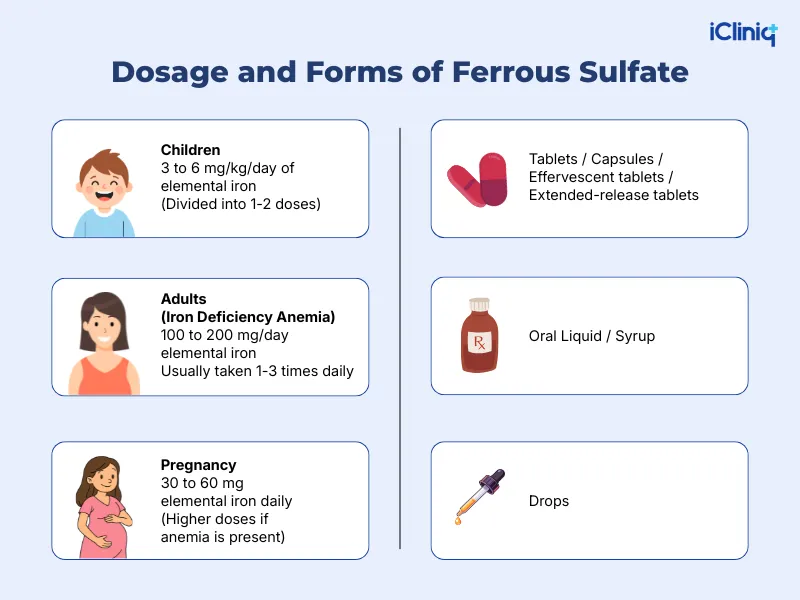
Available dosage forms and guidelines
Ferrous sulfate is an oral iron supplement that comes in a variety of forms such as tablets, caplets, capsules, oral solutions or liquids, and drops.
1. Tablets or caplets: They are a common form of iron supplements and come in dosages of either 200 mg or 325 mg, which is equivalent to 65 mg of elemental iron. They are not to be chewed but rather swallowed whole and not sucked or left in the mouth because this can cause tooth staining or mucous membrane ulcers.
2. Capsules: Capsules of Ferrous sulfate have become common; in some, an "extended release" function is added.
3. Oral solution or liquid: A liquid form of this medication is available. Perhaps this form may work better for a child or a patient with difficulty swallowing tablets. Several concentrations are available, so attention to detail is important in considering a particular concentration and volume for a given patient.
4. Oral drops: Such drops are made especially for infants and toddlers. They are given through a dropper, which is provided along with these drops.
What Should You Know About Missed Doses and Overdose Risks?
1. Missed dose:
If you forget a dose of Ferrous sulfate, you can take it when you remember. But never take a second dose because of a missed one. Taking too much iron can be a serious medical problem and can be life-threatening, particularly in infants.
2. Overdose:
An iron overdose is a medical emergency that requires emergency care. It may begin with gastrointestinal symptoms and progress to major systemic problems.
Nausea and severe stomach pain, vomiting that may contain blood or resemble coffee grounds, bloody or tarry diarrhea, shallow breathing, a weak and fast pulse, and pale skin with bluish lips or fingernails are among the symptoms that typically appear within six hours of ingestion.
What Are the Side Effects of Ferrous Sulfate?
Common side effects
Common side effects include gastrointestinal issues like:
-
Constipation (difficulty in passing stools).
-
Diarrhea (loose stools).
-
Nausea.
-
Abdominal cramps.
-
Pale skin.
-
Bluish lips.
These effects are mostly mild and can be managed by changing the dosage or taking the medication with food.
Serious side effects
Severe side effects include:
-
Allergic reactions may show up as a rash.
-
Itching.
-
Swelling.
-
Dizziness (unsteady).
-
Difficulty in breathing.
-
Shallow breathing.
-
Weak and rapid pulse.
Warnings and Precautions
Who should not take Ferrous sulfate?
Before taking Ferrous sulfate to ensure your safety, let your doctor know if you:
-
Have you ever experienced an allergic reaction to Ferrous sulfate or its components?
-
Have another type of anemia that is not caused by low iron levels.
-
Possess any additional disorders that impact your iron levels, such as hemochromatosis or hemosiderosis (excess iron buildup).
-
Have a disorder that impacts your red blood cells, such as thalassaemia or sickle cell anemia (an inherited disorder that affects the red blood cells).
-
Possess a stomach ulcer or have other bowel or stomach issues.
-
Issues like inflammatory bowel disease, frequent blood transfusions, blood in the urine, an iron deficiency diagnosis, and ongoing treatment.
What should you know before taking Ferrous sulfate?
-
Inform your doctor about any prescription or over-the-counter (OTC) medications, vitamins and minerals, herbal items, and other supplements you take before taking an iron supplement.
-
To prevent teeth discoloration, combine the elixir with fruit juice or water instead of milk or wine-based solutions.
-
If you take antibiotics like Tetracycline, Minocycline, and Doxycycline, you must take them two hours before or two hours after taking iron supplements.
What Interactions Can Occur With Ferrous Sulfate?
Drug interactions
Ferrous sulfate can reduce the effectiveness of a number of medications by decreasing their absorption. Important interactions consist of:
-
Antibiotics: Quinolones and Tetracyclines in particular.
-
Thyroid drugs: Thyroid drugs like Levothyroxine.
-
Drugs for heartburn and ulcers: Proton pump inhibitors (PPIs), H2 blockers, and antacids raise the pH of the stomach, which decreases the absorption of iron.
-
Bisphosphonates: Drugs like Alendronate are used to treat osteoporosis.
-
Dopaminergic: Levodopa and Carbidopa are examples of dopaminergic medications.
-
Penicillamine: Used to treat diseases such as Wilson's disease and rheumatoid arthritis.
-
Chloramphenicol: An antibiotic called Chloramphenicol may make iron therapy less effective.
-
NSAIDs: Iron and NSAIDs (nonsteroidal anti-inflammatory drugs) can both irritate the lining of the stomach, raising the risk of bleeding or stomach ulcers.
Food interaction
Iron absorption can be severely hampered by specific food ingredients and supplements. Iron doses ought to be spaced at least two hours from the following:
-
Dairy products that contain calcium include cheese, yoghurt, milk, and calcium supplements.
-
Tea and coffee: Contain substances that bind to iron, such as polyphenols.
-
Whole grains, eggs, and foods high in fibre.
-
When prescribed by a healthcare professional, vitamin C (ascorbic acid) can actually improve the absorption of iron.
Ferrous Sulfate Use During Pregnancy And Breastfeeding
Is Ferrous sulfate safe during pregnancy?
Your doctor may recommend that you take an iron supplement (Ferrous sulfate) in pregnancy if blood tests have shown that your iron levels are low.
Iron supplements are often safe to take in pregnancy, and it is also important that low iron levels are treated effectively so that you and your baby stay healthy.
Can you take Ferrous sulfate while breastfeeding?
You can usually take Ferrous sulfate while you are breastfeeding. Iron, including Ferrous sulfate, is a natural component of breast milk. When you take iron as a supplement, it does not affect how much gets into breast milk or how much gets to your baby.
This means that taking iron supplements usually does not cause any side effects to your baby. If the baby has low levels of iron, too, then they will have to be treated directly. Any iron supplements that you are on will not affect their levels.
How Should You Store Ferrous Sulfate?
Iron supplements are best stored at room temperature, between 68°F (Fahrenheit) and 77°F (20 °C and 25 °C). Store in a cool, dry place. Keep all medications away from children and pets. Store away from moisture and light.
Conclusion
Ferrous sulfate is an oral drug that is made and prescribed for iron deficiency treatment. It sets a gold standard for oral iron supplements. Constipation, nausea, diarrhea, dark stools, and stomach pain or discomfort are typical adverse effects. Overdosing on iron accidentally can be fatal, particularly in children under the age of six. Make sure children cannot access iron supplements. If you need any personalized advice, you can consult our specialist at iCliniq.
Key Takeaways
-
Ferrous sulfate is an iron supplement recommended to treat iron-deficiency anemia.
-
It guarantees that the body has adequate iron for the production of hormones, the health of the nervous system, and the basic operation of cells.
-
Ferrous sulfate comes with a lot of advantages, though it also has a few side effects. Always take iron supplement medication as advised by your health provider.