Table of Contents
- 1What Is Botox and How Does It Work on Skin?
- 2Can Botox Actually Treat Eczema?
- 3How Botox May Reduce Eczema Symptoms?
- 4Is Botox Safe for People With Eczema?
- 5Can Botox Trigger Eczema or Flare-Ups?
- 6Who Should Consider Botox for Eczema?
- 7Who Should Avoid Botox With Eczema?
- 8How Does Botox Compare to Standard Eczema Treatments?
- 9What Dermatologists Say About Botox for Eczema?
- 10Conclusion
- 11Key Takeaways
What Is Botox and How Does It Work on Skin?
Botox is a purified neurotoxin protein doctors use in very small amounts. It comes from a bacterium called Clostridium botulinum. Botox works by blocking nerve signals that tell muscles and sweat glands to work. This makes the treated area less active for a short time. Doctors use Botox to reduce wrinkles, control heavy sweating, and treat chronic migraines. Researchers are also studying it for skin conditions like eczema, rosacea, and psoriasis.
In eczema, Botox may help reduce itching and may help calm nerve-related inflammation. It may calm itch-related nerves and help stop the itch-scratch cycle that can worsen eczema symptoms.
Can Botox Actually Treat Eczema?
Botox is not a standard treatment for eczema yet. However, some studies show it may help certain people with eczema symptoms. A 2020 study found that some people with atopic dermatitis had less itching and irritation after Botox treatment. Many also said they slept better and felt more comfortable.
The treatment seemed to help more in severe eczema cases or cases that did not improve with usual treatments. Results were also better when eczema affected small areas like the hands, feet, or skin folds. More research is still needed to know how safe and effective Botox is for eczema in the long term.
How Botox May Reduce Eczema Symptoms?
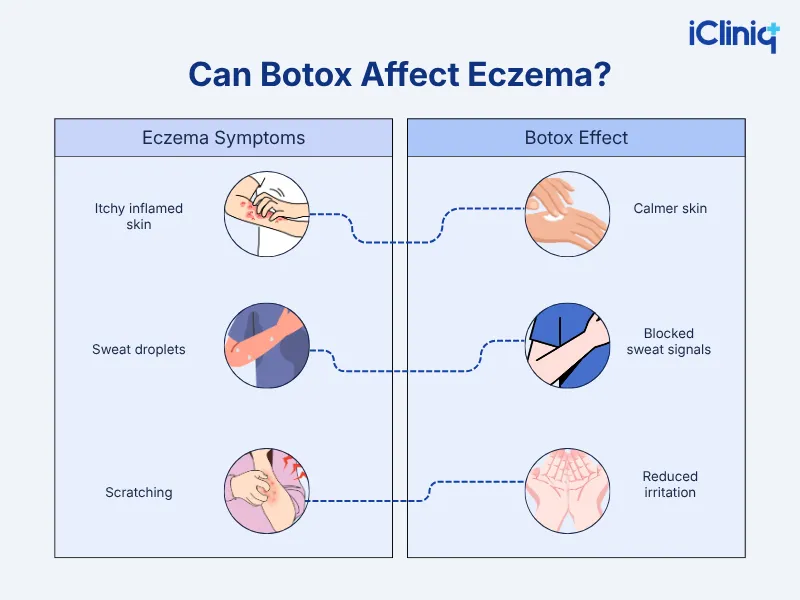
Botox may help reduce eczema symptoms in different ways.
-
It can block nerve signals linked to itching, which may help people scratch less.
-
It may also calm skin inflammation caused by overactive nerves. By reducing itching and scratching, Botox may help protect the skin barrier and lower the chance of flare-ups.
-
Some experts believe Botox may also help people whose eczema gets worse with sweating, especially in areas like the underarms, hands, feet, or skin folds.
Researchers are still studying how well Botox works for eczema and which patients may benefit the most.
Is Botox Safe for People With Eczema?
Botox is usually safe when a trained dermatologist gives it in small doses. Most side effects are mild and go away after a short time. Some people may get redness, swelling, bruising, or slight pain where the injection is given. Others may notice temporary dryness, itching, or mild muscle weakness near the treated area.
How safe Botox is can depend on the person, the dose, and how the injection is given. If you are thinking about Botox for eczema, speak with a dermatologist first. They can examine your skin and tell you if this treatment may be right for you.
Can Botox Trigger Eczema or Flare-Ups?
While Botox may help manage eczema symptoms, it can also trigger reactions in some people:
-
Botox may help eczema in some people, but it can also irritate the skin in others.
-
Some people may notice redness, itching, swelling, or mild pain after the injection. People with sensitive skin may also get a short eczema flare-up.
-
In rare cases, Botox may cause an allergic reaction.
-
Doctors usually avoid Botox on broken or infected skin because it may make the irritation worse.
Who Should Consider Botox for Eczema?
Botox may help some people with eczema, especially when regular treatments do not work well.
-
It may be useful for people with severe eczema or long-term itching that is hard to control.
-
Some doctors may also consider Botox for eczema on small or localized areas like the hands, feet, or skin folds.
-
People who cannot use corticosteroid creams for a long time may also discuss Botox as another option.
-
It may also help people whose eczema gets worse with sweating.
A dermatologist can help decide if Botox may be suitable for your skin condition.
Who Should Avoid Botox With Eczema?
Botox is not the right choice for everyone with eczema. Doctors usually avoid Botox in people with skin infections, open cuts, or badly irritated skin. People with very sensitive skin may also need to avoid this treatment.
Pregnant and breastfeeding women are often advised not to get Botox. People with muscle or nerve problems, such as Myasthenia Gravis, should also avoid it. People who are allergic to botulinum toxin should not get Botox injections. A dermatologist can check your skin and tell you if Botox is safe for you.
How Does Botox Compare to Standard Eczema Treatments?
|
Treatment |
Primary Use |
Onset |
Duration |
Availability |
|
Topical Corticosteroids |
Mild to moderate flares |
Days |
Short-term |
Widely available |
|
Calcineurin Inhibitors |
Sensitive areas |
1 to 2 weeks |
Medium-term |
Prescription |
|
Biologics (Dupilumab) |
Severe eczema |
2 to 4 weeks |
Long-term |
Specialty clinics |
|
Botulinum Toxin |
Off-label, severe cases |
3 to 7 days |
3 to 6 months |
Specialist only |
Botox may be used as an additional treatment in selected cases, not as a replacement for first-line treatments.
What Dermatologists Say About Botox for Eczema?
Dermatologists say Botox may help some people with eczema, but research is still limited. Right now, Botox is not a standard treatment for eczema. Doctors believe it may work best for people with severe or long-lasting itching that does not respond to standard treatments. It may also help when eczema affects small areas like the hands, feet, or skin folds. Most dermatologists do not recommend Botox for mild or widespread eczema. More studies are still needed to understand how safe and effective it is for long-term use.
Conclusion
Botox may be beneficial for some individuals with eczema, particularly those who experience severe itching or outbreaks associated with sweating. The use of Botox may be appropriate when conventional therapies for eczema do not provide adequate relief. Early clinical trials indicate that Botox injections can alleviate itching in some cases. Nonetheless, scientific evidence is currently insufficient, and Botox is not an established treatment for eczema. Consultation with a dermatologist should be undertaken before considering Botox therapy.
Key Takeaways
-
Botox may help reduce itching and nerve-related inflammation in some people with severe or long-term eczema.
-
It is not a standard eczema treatment and is still being studied for this use.
-
Botox may work better for small areas, such as the hands, feet, or skin folds.
-
Mild side effects can include redness, swelling, itching, or slight pain after the injection.
-
People with skin infections, broken skin, or pregnancy are usually advised to avoid Botox treatments. Always consult a dermatologist before considering Botox for eczema.

