
What Is Stage 0 Lung Cancer?
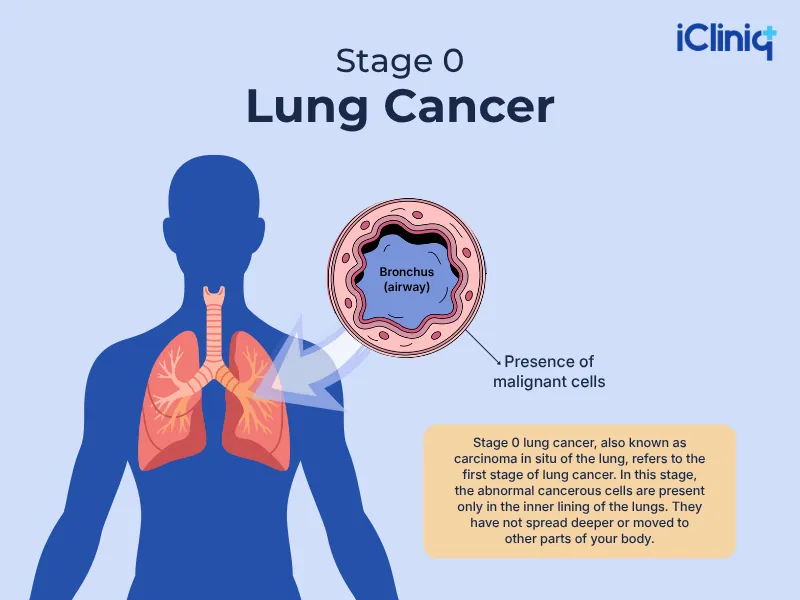
Stage 0 lung cancer, also known as carcinoma in situ of the lung, refers to the first stage of lung cancer. In this stage, the abnormal cancerous cells are present only in the inner lining of the lungs. They have not spread deeper or moved to other parts of your body. That is why it is called non-invasive lung cancer.
It is like a tiny mark, small, contained, and easier to remove before it grows. This makes early-stage lung cancer much less dangerous compared to later stages. In lung cancer staging 0, the disease is just beginning.
Survival Rate of Stage 0 Lung Cancer:
The survival rate of stage 0 lung cancer is very high. In many cases, you can be completely cured after treatment. Since the cancer has not spread, doctors can remove it early. The five-year survival rate is close to 100% for many patients.
| Feature |
Stage 0 Lung Cancer |
| Definition |
Non-invasive abnormal cells in the lung lining |
| Spread | No spread to lymph nodes or organs |
| Symptoms | Usually none |
| Detection | CT scan, biopsy |
| Treatment | Surgery (wedge resection) |
| Curability | Highly curable |
| Prognosis | Excellent |
Types of Stage 0 Lung Cancer
There are two main types of stage 0 lung cancer. Both are forms of non-invasive lung cancer, but they start in different cells inside your lungs.
Adenocarcinoma In Situ:
This type begins in the cells that produce mucus. It is a common form of early-stage lung cancer. The cells stay in one place and do not spread.
Squamous Cell Carcinoma In Situ:
This type starts in flat cells lining your airways. Like the other type, it remains on the surface and does not invade nearby tissue.
Symptoms of Stage 0 Lung Cancer
Here is something surprising: symptoms of stage 0 lung cancer are usually not present. Yes, you might not feel anything unusual at all. Because the cancer is so small, your body may not react to it. This is why many people discover it during tests done for other reasons.
In rare cases, you might notice the following symptoms:
-
A mild cough that does not go away.
-
Slight discomfort in your chest.
-
Small changes in your breathing.
But these signs are uncommon and can occur for many other reasons as well. So, how can something serious stay hidden in your body? That is because it has not started affecting nearby tissues yet.
Causes and Risk Factors
There is, as such, no definitive known cause of stage zero lung cancer yet, but some factors are known to increase your risk of getting lung cancer. These include the following:
-
Smoking.
-
Secondhand smoke breathing.
-
Air pollution.
-
Exposure to certain harmful chemicals, such as asbestos, arsenic, beryllium, chromium, nickel, cadmium, and silica.
-
Family history of lung cancer.
-
Radon gas exposure.
Smoking is the biggest risk factor. However, even if you have never smoked, you can still develop early-stage lung cancer. That may sound surprising, but it shows how complex your body can be.
How is Stage 0 Lung Cancer Diagnosed?
Since you may not notice any symptoms of stage 0 lung cancer, doctors often find it through tests.
Common methods include:
-
CT (computed tomography) scans to spot small changes in your lungs.
-
Biopsy to study lung cells closely.
A biopsy helps confirm whether the cells are cancerous. If you are at high risk, your doctor may suggest regular screening. These scans can detect lung cancer staging 0 early, sometimes before you feel anything at all.
Stage 0 Lung Cancer Treatment Options
The main treatment for stage 0 lung cancer is surgery. Since the cancer is small and contained, doctors can remove it completely. The most common option is a Wedge resection, in which a small part of your lung is removed.
Because this is non-invasive lung cancer, you usually do not need chemotherapy or radiation. After treatment, you can often return to your normal routine. Early treatment makes your recovery smoother and faster.
Can Stage 0 Lung Cancer Progress?
Yes, stage 0 lung cancer can grow if it is not treated. The abnormal cells may spread deeper into your lung tissue and become more serious. Think of it like a small problem that grows bigger over time. If you take action early, you can stop it before it becomes harmful. So even though stage zero lung cancer is not dangerous at first, it is still important to treat it.
When to See a Doctor?
Since you may not notice clear symptoms of stage 0 lung cancer, regular health check-ups are important.
You should see a doctor if you notice the following:
-
A cough that does not go away.
-
Changes in your breathing.
-
Long-term exposure to smoke or harmful substances.
If you are at higher risk, lung cancer screening can help detect early-stage lung cancer before it causes trouble.
Waiting for symptoms is not always the best choice. Taking early action helps protect your health.
Conclusion
Stage 0 lung cancer is the earliest and easiest stage to treat. It is called carcinoma in situ of the lung because it remains confined to one place and does not spread. You may not notice any symptoms, but modern tests can find it early. It is important to visit a lung cancer specialist, talk about your concerns, and get screened if needed. Knowing about early-stage lung cancer helps you stay alert and take action on time. The survival rate of stage 0 lung cancer is very high, and treatment is usually simple. When you understand what is happening in your body, you can make better choices for your health. Sometimes, early awareness can make a big difference.
Key Takeaways:
- Stage 0 lung cancer is the earliest stage, also known as stage zero lung cancer" or "carcinoma in situ lung." The abnormal cells are only present in the lung lining and have not spread, making it a non-invasive lung cancer.
- The survival rate of stage 0 lung cancer is extremely high, with many people fully recovering after treatment.
- Symptoms of stage 0 lung cancer are usually absent, which makes early screening very important. Regular check-ups and screenings can help detect early-stage lung cancer before it progresses.
- People with risk factors like smoking or long-term exposure to harmful substances should be more careful.
- Surgery, such as Wedge resection, is the most common and effective treatment for stage 0 lung cancer.
- If left untreated, it can progress to a more advanced stage, so early action is essential.

