Table of Contents
-
Key Takeaway:
-
The most common causes of pain under the right ribs are heartburn or a strained rib, but it can also originate from organs such as the liver, gallbladder, stomach, or kidney.
-
If it’s a muscle strain, it usually feels better in a few days. A bruised rib can hurt for weeks, and a broken rib can take 6 weeks or more to heal.
-
If the pain doesn’t start getting better after a few days, it’s essential to see a doctor who can guide you on what to do next.
What Does Pain Under the Right Rib Cage Mean?
Your rib cage is like a strong, bony basket in your chest made of 12 pairs of ribs. This basket protects important body parts, including your heart, lungs, and various organs of the digestive system, such as the liver, gallbladder, spleen, and stomach. When someone has pain under the right rib cage, it means they feel aching or discomfort under or around the ribs on the right side of their chest or upper belly. It’s just describing where the pain is.
What Are the Causes of Pain Under the Right Rib Cage?
Pain under the right rib cage can occur for various reasons. Sometimes it’s something simple, like sore muscles. At other times, it can be caused by digestive problems, such as heartburn. It can also occur due to issues with the organs located under the right rib cage, such as the liver or gallbladder, or from problems with the lungs, heart, or kidneys.
Let's take a closer look at the causes:
1. Musculoskeletal causes:
Sometimes, pain under the right rib cage can happen because of a fall, a car accident, or a hit during contact sports.
These problems can cause:
-
Muscle strain (happens when you stretch your muscles too much by doing something super fast).
-
Rib fracture or bruise.
-
Costochondritis (this means the cartilage that connects your ribs to your breastbone gets swollen and sore).
2. Digestive issues:
Sometimes, pain under the right rib cage can happen because something is going on with the digestive organs that live in that area.
Here’s what that can mean:
-
Gallbladder issues: Pain can be due to:
-
Gallstones (hard little stones inside the gallbladder).
-
Cholecystitis (inflammation of the gallbladder).
-
-
Liver problems: Pain may be due to:
-
Liver abscess.
-
Fatty liver.
-
Hepatitis (inflammation of the liver).
-
In rare cases, liver cancer.
-
-
Kidney conditions: Pain could be due to issues with the right kidney, or:
-
Kidney stones.
-
Infection in the kidney.
-
Urinary tract infections.
-
Presence of a tumor.
-
-
Digestive causes: This includes:
-
Acid reflux, or gastroesophageal reflux disease (GERD).
-
Gastritis (stomach lining gets inflamed).
-
Peptic ulcers (sores in the stomach).
-
Dyspepsia (indigestion).
-
Constipation.
-
Inflammatory bowel disease (IBS).
-
Appendicitis (when the appendix, a tiny finger-shaped pouch, gets swollen).
-
Pancreatitis (inflammation of the pancreas).
-
3. Lung conditions:
Even your lungs can make the right side hurt. This includes:
-
Lung infection (pneumonia).
-
Pleurisy (when the lining around the lungs gets irritated).
-
Pulmonary embolism.
4. Heart issues:
Pericarditis means the lining around the heart gets swollen and irritated. It can cause pain on the right side under the ribs.
5. Skin issues:
Shingles is a type of painful rash with blisters. It can cause the skin on one side of your body, such as the right side under your ribs, to hurt, burn, or feel extremely sensitive.
6. Others:
Preeclampsia is a health problem that can happen during pregnancy. It can raise blood pressure too high, and it can also cause pain in the upper right quadrant of the abdomen, located under the ribs.
What Symptoms Accompany Right Rib Cage Pain?
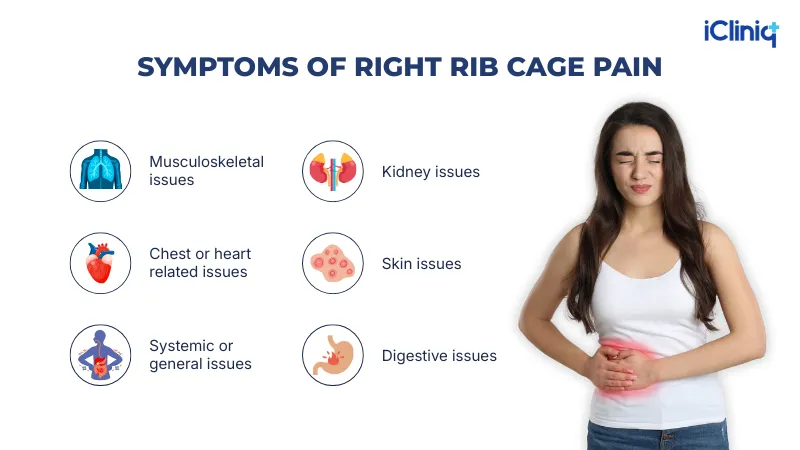
When someone experiences pain under their right rib cage, they may also notice other signs. These clues can help explain what’s going on in the body.
Musculoskeletal issues:
A person may have:
- Swelling or tenderness (it hurts when you touch it).
- Bruising.
- Pain that gets worse when they move, cough, sneeze, or laugh.
Chest issues:
- If the lungs or chest are involved, there may be:
- Shortness of breath.
- Chest tightness.
- Pain when taking a deep breath.
- In serious cases (like a pulmonary embolism), there may also be a fast or irregular heartbeat and coughing up blood.
Digestive issues:
If the pain is coming from the liver, gallbladder, or other digestive organs, a person might feel:
- A burning feeling in the chest or belly.
- Sharp pain after eating.
- Nausea or vomiting.
- Bloating or gas.
- Jaundice.
- Dark pee or light-colored poop.
- Weight loss.
- Belly tenderness.
- Blood in stool or vomit.
Kidney issues:
If the right kidney is the problem, symptoms may include:
- Burning feeling when peeing.
- Blood in the urine.
Systemic or general issues: sometimes the whole body gives signs, like
- Fever.
- Dizziness.
- Feeling very tired.
- Sweating a lot.
- Losing weight without trying.
Heart-related issues: If the heart is involved, a person may feel:
- Heart palpitations (the heart feels like it’s racing or skipping beats).
- Pain when swallowing.
- Fever.
Skin issues: With shingles, the skin along one side of the ribs may feel burning, tingling, or stinging. And later, a painful rash with blisters.
How Is Pain Under the Right Rib Cage Diagnosed?
To figure out why someone has pain under their right rib cage, doctors do a few simple steps:
1. Initial assessment:
Medical history: The doctor will ask questions like:
This involves:
- Where does it hurt?
- What does the pain feel like? Is it sharp? Dull?
- When does it hurt more or less?
- What makes it better or worse?
- Are there any other symptoms? (like fever, nausea, or trouble breathing).
- This helps the doctor understand what may be happening inside the body.
Physical examination: The doctor might:
- Press gently on the belly and ribs to check for swelling or sore spots (this is called palpation).
- Ask the person to move or bend to see if it hurts (range-of-motion tests).
- Do special little tests to check for things like slipping rib syndrome.
2. Diagnostic tests:
Sometimes doctors need special tests to understand what’s causing the pain. These tests include:
-
Blood tests: A small amount of blood is taken to check for infections, inflammation, and liver and kidney function tests.
-
Imaging tests: These include:
-
X-rays: Show the bones and can help find rib fractures.
-
Chest X-ray: Checks the lungs.
-
Ultrasound: Helps the doctor see the liver, gallbladder, and other organs.
-
Computed tomography (CT) scan: Gives very detailed pictures of organs, bones, and blood vessels.
-
Magnetic resonance imaging (MRI): Shows soft tissues like muscles and organs.
-
Bone scan: Used if the doctor thinks there might be cancer or long-term bone problems
-
-
Electrocardiogram (ECG) and ECHO (echocardiogram): These tests are done if the doctor thinks the heart might be causing the pain.
-
Urine tests: These are used when the doctor thinks the kidneys might be the problem.
-
Endoscopy: This test uses a tiny camera to look inside the stomach and digestive system if tummy problems are suspected.
The way doctors treat the pain depends on what’s causing it. Different problems need different fixes! Treatments can include:
-
Medicines to help with pain, swelling, or infection.
-
Lifestyle changes, such as eating healthier foods or getting more rest.
-
Surgery, but only in very serious cases (like a gallbladder or liver problems)
Conclusion:
Right rib cage pain can occur for several reasons, including muscle strain, rib injury, or issues with the organs located under the ribs. If the pain doesn’t improve after a few weeks, doesn’t subside with rest, or suddenly becomes very severe, it’s essential to consult a doctor. If the pain comes with other symptoms, a general physician can help find out what’s going on inside your body and give the right treatment so you can feel better.