High-Intensity Focused Ultrasound Therapy - Indications, Advantages, and Side Effects

Verified data

3 min read

Share
Facebook Telegram LinkedIn WhatsApp

Outline

High-intensity focused ultrasound therapy uses very focused ultrasound waves to heat or destroy tissue. Read this article to know more about it.

Medically reviewed by Dr. Kaushal Bhavsar
Published At October 26, 2022
Reviewed At December 16, 2025

Education:

BDS

Professional Bio:

Dr. Ramji R. K is an enthusiastic Dental Surgeon with expertise in preventive, restorative, and cosmetic dentistry. He is passionate about creating healthy, confident smiles through advanced dental care and patient-centered treatment. His areas of specialization include oral surgery, root canal therapy, smile design, and overall dental wellness, ensuring comfort and quality in every procedure.    

This doctor is not available for online consultations on the platform anymore.

Education:

MBBS

Professional Bio:

Dr. Kaushal Bhavsar is an experienced Internal Medicine Specialist and Pulmonologist with expertise in managing respiratory conditions such as asthma, COPD, tuberculosis, and lung infections, along with chronic illnesses like diabetes, hypertension, and metabolic disorders. He is skilled in critical care, pulmonary function testing, and evidence-based medical management. Dr. Bhavsar is committed to delivering holistic, patient-centered care for long-term health and respiratory wellness.    

This doctor is not available for online consultations on the platform anymore.

Table of Contents

What Is High-Intensity Focused Ultrasound (HIFU) Therapy?

High-intensity focused ultrasound treatment is a painless procedure that cuts through tissue using highly focused ultrasound waves. The ultrasound beams safely pass through the skin and other tissues without harming them. Doctors use MRI or ultrasound images to guide and monitor the treatment. Hence, it is also known as magnetic resonance-guided focused ultrasound surgery (MRgFUS) or focused ultrasound surgery (FUS)

How Does HIFU Work?

The HIFU special tool is used in high-intensity focused ultrasound, which focuses strong ultrasound waves on a tiny area inside the body. These waves heat the tissue to approximately 70 to 80°C, thereby killing the targeted area. During treatment, doctors guide the procedure and monitor the amount of heat generated using MRI or ultrasound images.

How Does HIFU Treat Prostate Cancer?

HIFU is a way to treat prostate cancer by heating and killing the cancer cells with very focused ultrasound waves. Not having to insert anything into the body makes this treatment much safer than treatments such as radiation or chemotherapy and less likely to damage healthy tissue.

You may receive HIFU in two forms:

  • Whole-gland HIFU: Treats the entire prostate.

This is typically how the process flows:

  • You will be put to sleep with general or spinal anesthesia, and you will rest your legs on something on the operating table.

  • While you are sleeping, a small ultrasound tool called a transducer is carefully placed into your rectum.

  • The probe provides the physician with clear images of the prostate to help him determine where treatment should be applied.

  • Focused ultrasound waves are directed to specific locations by a probe. The waves kill cancerous cells because they heat them so much.

  • It's simply delivering energy to the tumor while leaving the surrounding good tissue largely unaffected.

Depending on the tumor size, the treatment typically takes between two and three hours on average. After the treatment, an MRI or ultrasound is performed to assess its effectiveness.
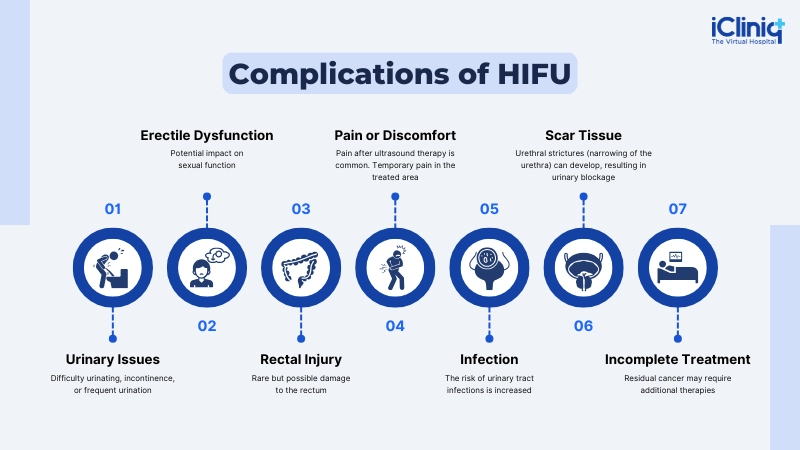
Complication of HIFU

What Are the Other Clinical Indications of HIFU?

The clinical indications of HIFU include

  • It is also used in the treatment of other cancers like liver, breast, pancreas, and kidney cancer.

  • Bone metastases (spread).

  • Skin tightening.

  • Neurological disorders like Parkinson's disease.

  • Uterine fibroids (noncancerous growths in the uterus).

  • Benign prostate hyperplasia (swelling of the prostate gland that is not cancerous).

What Are the Advantages of HIFU?

The major advantages of HIFU include

  • Noninvasive.

  • Precisely target diseased tissue.

  • Does not cause harm to healthy tissue.

  • Faster recovery time.

  • HIFU is a safer way to treat cancer than chemotherapy and radiotherapy.

  • Low treatment risk.

What Are the Side Effects of HIFU?

HIFU side effects are predicated on a person's condition. Many people suffering from prostate cancer have fewer side effects from the treatments of HIFU as compared to chemotherapy and radiation therapy.

The side effects include

  • Urinary issues: Difficulty urinating, incontinence, or frequent urination.

  • Erectile dysfunction: Having trouble maintaining an erection, which can affect sexual performance.

  • Rectal injury: HIFU side effects can cause rare but possible damage to the rectum.

  • Scar tissue: Urethral strictures (narrowing of the urethra) can develop, which can lead to urinary blockage.

  • Pain or discomfort: It's normal to feel pain after ultrasound therapy. Temporary pain in the treated area.

  • Prostate infection: Urinary tract infections are more common after the procedure.

  • Incomplete treatment: Residual cancer may require additional therapies.

Conclusion:

HIFU has numerous applications in medical care. It is minimally invasive with a shorter recovery time, leading to its popularity. HIFU helps reduce recurrence and improve the prognosis in localized prostate cancer patients.

Key Takeaways

  • HIFU (High-Intensity Focused Ultrasound) is a non-invasive treatment that utilizes focused ultrasound waves to target and destroy unwanted tissue.

  • It can naturally lift and tighten the skin on your face and treat certain types of cancer and non-cancerous growths.

  • The procedure is precise, spares healthy tissue, and generally allows a faster recovery than surgery or traditional therapies.

  • Most side effects are mild, such as short-term pain or minor changes in urination.

  • Talk to your doctor about your choices for safe and effective results.

Frequently Asked Questions

What Are the Uses of Ultrasound?

Ultrasound Imaging techniques record the body's internal organs through sound waves to produce pictures.The uses of ultrasound Imaging are:
 - Helps to detect the cause of pain.
 - Presence of any swelling or infection within the organs.
 - Examine the status of the baby within the womb

What Is the Time Taken for a HIFU Procedure?

High-intensity focused ultrasound is a minimally invasive diagnostic procedure that uses very high-intensity sound waves to detect or examine the internal body parts, which takes one to two hours.

Is HIFU Beneficial for the Patient?

High-intensity frequency ultrasounds are used in treating:
 - Wrinkles.
 - Skin sagging.
 - Facial lifting procedures like cheek, eyebrow, and eyelid lifting.
 - Skin smoothening.
 - Jawline defining and enhancement.

How Successful Is a HIFU Procedure?

High-intensity frequency ultrasounds are a very successful treatment. It is considered one of the safest and most effective treatments, as it requires no incision, resulting in no scarring and minimal resting time.

Can a HIFU Procedure Be Harmful, Causing Deleterious Side Effects?

No, HIFU treatment procedures are highly safe and not harmful. The procedures show symptoms like 
 - Redness.
 - Swelling.
 - Temporary numbness.
 - Bruising.
 - While these symptoms last only a few days gradually fade away.

What Are the Precautions To Be Taken During HIFU?

There are a few considerations to have in mind post a HIFU Procedure, and they are 
 - Staying hydrated.
 - Restraining from scratching the skin. 
 - Avoiding hot water showers.
 - Avoiding exposure to sunlight. 
 - Avoiding alcohol intake.

Can the Effect of HIFU Be Permanent in the Body?

Although the facial fat loss occurring during HIFU treatments is permanent, the longevity of high-intensity frequency ultrasounds after one sitting usually lasts twelve to twenty-four months. After which another sitting of the procedure can be performed.

Is HIFU a Very Painful Procedure?

No, HIFU is not a very painful procedure. Still, patients may experience slight discomfort, a feeling of warmth, or a tingling sensation. This discomfort occurs as the HIFU Procedure uses high-intensity ultrasound, which can result from such feeling on contact with the skin.

Can Hifu Accelerate Facial Aging?

On the contrary, during the HIFU Procedure, the ultrasound activates the body's healing process, thus activating the collagen. This, in turn, makes the skin look more nourished, supple, and younger than before.

Does Hifu Help in Facial Fat Loss?

The high-frequency ultrasounds target the fat cells depleting them, which in turn causes permanent loss of Facial fat. However, there might be a minimal regeneration of the cells on recurrent sitting, resulting in permanent loss of Facial Fat.

What Are the Effects of Hifu on the Prostate?

High-Intensity Frequency ultrasounds provide a targeted approach in the Prostrate where the approach is in a focal point targeting the tissues.HIFU in the Prostate is used for treating:
 - Prostatic cancers.
 - Non-cancerous tumors of the prostate.
 - Enlarged prostate.
Source Article Iclon Sources Source Article Arrow
Comprehensive Second Opinion

Ask your health query to a doctor online

Medical oncology

*guaranteed answer within 4 hours

Disclaimer: No content published on this website is intended to be a substitute for professional medical diagnosis, advice or treatment by a trained physician. Seek advice from your physician or other qualified healthcare providers with questions you may have regarding your symptoms and medical condition for a complete medical diagnosis. Do not delay or disregard seeking professional medical advice because of something you have read on this website. Read our Editorial Process to know how we create content for health articles and queries.
