What Is Clobetasol Propionate?
Clobetasol propionate is a topical steroid that is super-potent. It is more powerful than the majority of other steroid creams or ointments. It reduces redness, swelling, itching, and burning of the skin associated with various skin ailments. It comes as:
-
Clobetasol cream.
-
Clobetasol ointment.
-
Clobetasol topical solution propionate.
-
Foam, spray, gel, and shampoo.
Due to its significant power, physicians recommend its application on a limited basis and in specific locations.
How does it work?
Clobetasol is effective in reducing the excessive immune response of the body to the skin. It reduces swelling, decreases itching, and slows down the rapid multiplication of skin cells. This is the reason it is used in cases of psoriasis and eczema flare-ups.
Available forms and formulations:
Clobetasol is a drug in numerous forms:
-
Cream: Suitable for dry or moist skin.
-
Ointment: More suitable for thick, dry, or scaly skin.
-
Solution or lotion: Frequently applied to the scalp.
-
Spray and foam: This can be used on big or hairy places.
-
Shampoo: For scalp psoriasis.
The forms contain an equal amount of a strong steroid and perform better in various areas based on the type of skin.
When and Why Is Clobetasol Prescribed?
Clobetasol in skin problems that do not respond to less powerful steroid creams are prescribed by doctors to patients. It assists in managing the sudden outbreaks and intense symptoms.
Clobetasol is used in cases where the skin is highly inflamed, is quite itchy or thick, and does not respond to weaker steroid creams. Physicians prescribe it as a treatment of acute flare-ups of skin diseases like psoriasis, eczema, lichen simplex chronicus, lichen sclerosus (including itching and burning of the vulva), contact dermatitis (skin irritation), discoid lupus (autoimmune disease that causes scaly patches), psoriasis on the scalp, and excessive dandruff, allergic rashes, thickened inflammatory patches of the skin, and severe itching. It assists in the quick reduction of swelling, irritation, and scaling. Due to its super-potent steroid, it is never taken long-term and is only administered when one really needs an intensive treatment.
What Is Clobetasol Propionate Cream Used For?
The most common uses of Clobetasol cream are:
-
Erythematous, or swollen skin.
-
Thickness, e.g., psoriasis plaques.
-
Rashes of eczema behind the knee, elbow, or folds in the body.
-
Itchy skin diseases of the vulva, such as lichen sclerosus.
-
Allergy-induced or irritant rashes.
The creams are most effective with normal and moist skin. Ointments are preferred in very dry and thick places. The applications of Clobetasol propionate are:
-
Psoriasis: It is a chronic skin disease characterized by thick, red, and scaly patches of the skin, resulting from an excessive rate of skin cell proliferation.
-
Eczema (atopic dermatitis): It is an inflammatory and itchy skin condition that is characterized by skin dryness, redness, and flare-ups.
-
Lichen simplex chronicus: This is thick, leathery skin resulting from frequent scratching or rubbing.
-
Lichen sclerosus (including vulvar itching and burning): A chronic type of skin disease leading to thin white itchy spots, which are usually relieved using Clobetasol.
-
Contact dermatitis: A red, itchy rash that results from contact with an irritant or an allergen.
-
Discoid lupus: It is a chronic autoimmune disorder characterized by the development of round, scaly spots that may lead to skin scarring.
-
Psoriasis of the scalp and dandruff: A scalp disease is characterized by thick, crusty scales and flakes that resemble dandruff in severe cases.
-
Allergic rashes: Skin reactions to allergens, which are red, swollen, and itchy.
-
Thickening of the skin (inflammatory): The inflammation causes the skin to thicken due to scratching or other irritations.
It is not recommended for use in cases of acne, fungus, or bacterial infections. Clobetasol propionate for acne is not safe and can increase the breakouts.
How to Use Clobetasol?
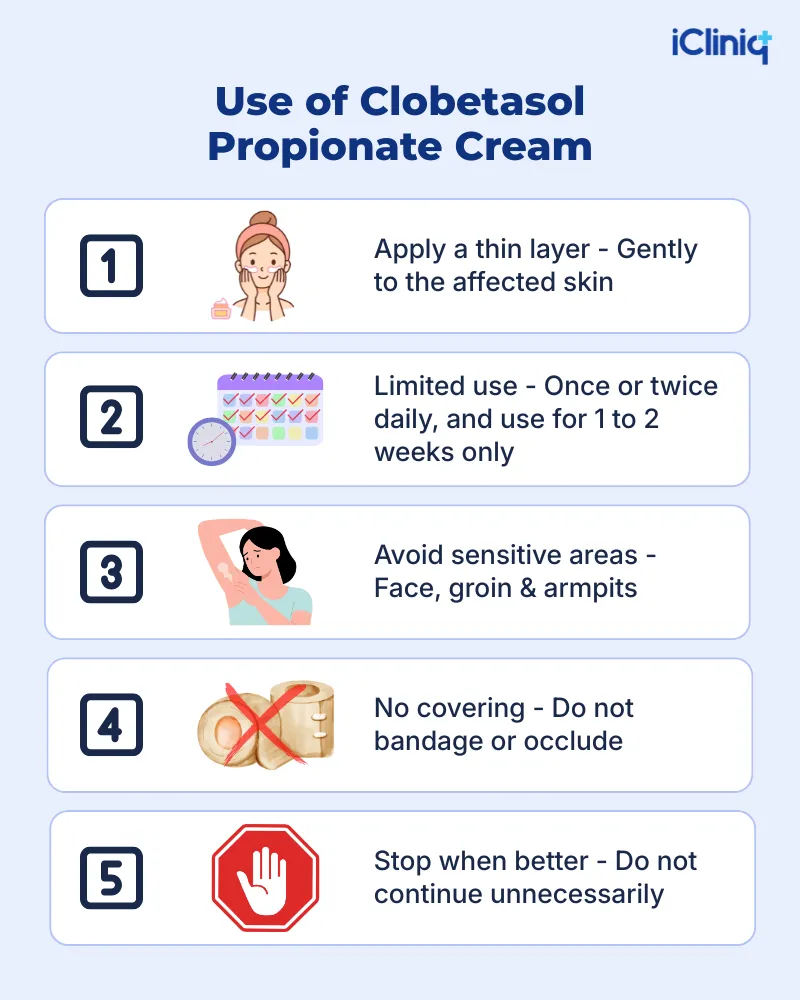
Here is a guideline about Clobetasol propionate uses:
1. Step-by-step application guide
-
Wash and dry your hands.
-
Wash and clean the skin of the affected area.
-
Apply a thin layer. You only need a small amount.
-
Rub it lightly. Do not bandage without the permission of your doctor.
-
You have to wash your hands after applying it.
-
Do not put it on the eyes, mouth, and private parts unless it was prescribed for these areas.
2. Frequency and duration
Since Clobetasol is very potent, apply it with caution:
-
Usually once or twice daily.
-
Frequently, it is a 12 to 14-day prescription.
-
Not to be used over a period of more than two weeks unless prescribed by a physician.
-
When taken over time, it may lead to serious side effects.
Your doctor can put you on a timetable that yields less frequency as time passes with chronic disorders such as lichen sclerosus.
3. What to avoid?
While using Clobetasol:
-
Do not apply it to the face, unless directed to do so by your doctor.
-
Should not be applied to acne or rosacea.
-
Should not be used in skin folds (groin, armpits) unless instructed.
-
On the treated part, avoid the sun or tanning beds.
-
Do not overuse it, as it may cause the skin to become itchy. The excessive consumption may result in skin thinning, stretch marks, or dependency on steroids.
4. Storage and disposal
-
Store at room temperature.
-
Store in a location away from heat or direct sunlight.
-
Keep the cap tightly closed.
-
Do not freeze.
-
Keep away from children.
-
Check expiry before using.
-
Do not put it in the sink or toilet. Wrap and put in ordinary waste.
What Are the Side Effects of Clobetasol?
Clobetasol is powerful. It is therefore an effective but more side-effect-laden drug than the less potent steroid creams.
1. Common or local side effects
Such are typical and typically mild:
-
Burning or stinging skin.
-
Dry or peeling skin.
-
Redness.
-
Thinning of the skin.
-
Stretch marks.
-
Visible small blood vessels.
-
Mild irritation.
-
Easy bruising.
-
Growth of hair in the region of treatment.
The effects tend to vanish once the drug is discontinued.
2. Long-term risks
The excessive long use of Clobetasol may result in:
-
Severe skin thinning.
-
Dark or light patches.
-
Permanent stretch marks.
-
Skin tears.
-
Steroid-induced rosacea.
-
Delayed wound healing.
-
Overgrowth of fungus on the skin leading to fungal infections.
Such issues are more prevalent on sensitive skin, such as the face, neck, or intimate areas.
3. Systemic risks
A very strong steroid may get into the bloodstream if used:
-
Over a large area.
-
For a long time.
-
Under tight bandages.
-
On broken skin.
In children, the systemic side effects comprise:
-
Weight gain.
-
Mood changes.
-
High blood sugar.
-
Slow growth in children.
-
Cushing syndrome.
They are more likely to occur in cases of incorrect medication usage.
4. Special caution
Extra care is needed in:
-
Children (greater risk of absorption).
-
Pregnant women.
-
People with diabetes.
-
Individuals whose skin is thin or sensitive.
-
Elderly patients.
-
Alterations in the vulva (take as prescribed).
-
Skin disorders that require potent steroids.
Alternatives and When to Consider Them?
In case of excessive strength or irritation by Clobetasol, the clinician can recommend:
-
Low or medium strength steroids.
-
After failing to restrain the illness, the patient received calcineurin inhibitors (Tacrolimus, Pimecrolimus).
-
Vitamin D creams (Calcipotriol).
-
Coal tar or salicylic acid preparations.
-
Long-term emollient therapy (using a cream to soften the skin).
-
Resistant cases.
-
Severe disease immunomodulator drugs.
Alternatives to Clobetasol propionate are used when:
-
Symptoms become better, and a less potent steroid is required.
-
Treatment needs to be long-term.
-
Delicate places require safer options.
-
Side effects develop.
-
Relapse of the condition occurs soon after withdrawal of Clobetasol.
When to See a Doctor?
You are to consult your physician in case:
-
The rash worsens with the application of Clobetasol.
-
There are pus, oozing, yellow crusts.
-
You get a fever and a rash.
-
The skin is much thinner and more easily torn.
-
Stretch marks are instantly present.
-
You experience dizziness, weight increase, or mood changes.
-
The medicine has a strong reaction in children.
-
You do think it is an allergic reaction.
Serious side-effects:
See the doctor at once, in case of observation of:
-
Severe burning or pain.
-
Vision changes.
-
Rapid weight gain.
-
Severe skin thinning.
-
Change of hormones, such as irregular periods.
-
Swelling of the face or limbs.
-
Infection symptoms of the treated region.
They can indicate that the steroid is being absorbed excessively or that the steroid is having a systemic effect.
Conclusion
One of the potent topical steroids is called Clobetasol propionate. It works as a fast-acting reliever of redness, swelling, itchiness, and thick skin patches caused by most skin diseases. Even as it is highly effective, it should be applied sparingly. The short-term, physician-prescribed usage is harmless to the majority of people. Prolonged or misuse may cause severe side effects. The least amount should be used in the shortest time possible. In case of any side effects or worsening of symptoms, it is advisable to consult a general practitioner online.
Key Takeaways
-
Clobetasol propionate is a super-potent topical steroid that is employed in the management of severe itching, redness, and thickened skin in psoriasis, eczema, lichen sclerosus, and allergic rashes.
-
Due to its extremely high potency, Clobetasol should not be used regularly in large quantities or over extended periods of time, as prolonged use may cause skin thinning, stretch marks, and hormonal effects.
-
One should always adhere to the doctor's prescriptions and not apply Clobetasol to the face or other sensitive parts of the body unless recommended.