Table of Contents
- 1How Does Flurpiridaz F 18 Assist in Diagnosing Myocardial Ischemia and Infarction?
- 2What Are the Side Effects of Flurpiridaz F 18?
- 3What Are the Things to Inform the Doctor Before Taking Flurpiridaz F 18?
- 4How Is Flurpiridaz F 18 Administered?
- 5What Are the Pharmacological Actions of Flurpiridaz F 18?
- 6What Are the Drug Interactions of Flurpiridaz F 18?
Overview
Flurpiridaz F 18 is a novel positron emission tomography imaging agent newly approved by the U.S. (United States) Food and Drug Administration (FDA) on September 30, 2024. The newly invented diagnostic imaging tool is for adults diagnosed with, or suspected of having, coronary artery disease. It is referred to as the widening or blockage of coronary arteries, which could then lead to heart problems.
Flurpiridaz F 18 helps cardiovascular imaging improve imagery of the structure and function of the heart. It makes the healthcare professional assessment of the myocardial perfusion- every process of flowing blood to that heart muscle- easier. It is essential for survival, not to talk of proper functioning.
Flurpiridaz F 18 also helps diagnose conditions related to myocardial ischemia, a reduced blood flow to the heart, like myocardial infarction, commonly termed a heart attack. Its novel formulation and advanced imaging qualities place it at the top of the list regarding novelty for cardiac imaging applications.
Drug Group
Flurpiridaz F 18 belongs to the drug group known as radiopharmaceuticals. Specifically, it is used as a diagnostic imaging agent for myocardial perfusion imaging (MPI) in assessing coronary artery disease (CAD).
Indications
Flurpiridaz F 18 is used for positron emission tomography (PET) myocardial perfusion imaging (MPI), which evaluates blood flow to the heart muscle. It can be performed during rest or under stress through exercise or medication. This test is for adult patients with known or suspected coronary artery disease (CAD) to detect reduced blood flow (myocardial ischemia) or heart muscle damage (infarction).
Dosage Forms and Available Strengths
Flurpiridaz F 18 is a radiopharmaceutical agent designed for intravenous use, primarily in imaging procedures such as PET (positron emission tomography) scans.
Injection: 190 MBq/mL (megabecquerels per milliliter) to 2,050 MBq/mL (5 mCi/mL (millicuries per milliliter) to 55 mCi/mL) of Flurpiridaz F 18 in a shielded, multiple-dose vial with a fill volume of up to 30 mL (milliliters) at the end of synthesis.
The drug is administered only by the trained healthcare provider.
For Patients
How Does Flurpiridaz F 18 Assist in Diagnosing Myocardial Ischemia and Infarction?
Flurpiridaz F 18 is a PET imaging agent that visualizes blood flow to the heart's myocardium muscle. The substance contains a radioactive tracer called fluorine-18, infused into the bloodstream. During its journey within the body, the tracer emits small or minute radiation levels that a PET scanner picks up and records.
The main focus of Flurpiridaz F 18 is assessing myocardial perfusion, that is blood flow to the heart. The portions of the heart well-perfused usually take up the tracer, whereas those regions whose perfusion is compromised due to myocardial ischemia the reduced flow of blood to the heart infarction heart attack take less tracer.
The PET scan creates high-resolution images showing the extent to which blood supplies different parts of the heart muscle. It helps doctors identify areas of blockage or damage in the coronary arteries and make proper treatment decisions. Its advanced imaging capability improves its diagnosis of heart conditions such as CAD, myocardial ischemia, and infarction.
What Are the Side Effects of Flurpiridaz F 18?
Common Adverse Reactions (More Than Two Percent of Subjects)
-
Dyspnea (shortness of breath).
-
Headache.
-
Angina pectoris (chest pain).
-
Chest pain.
-
Fatigue.
-
Flushing.
-
Nausea.
-
Abdominal pain.
-
Dizziness.
-
Arrhythmia (irregular heartbeat).
Less Common Adverse Reactions (Less Than Two Percent of Subjects)
-
Diarrhea (loose, watery stools).
-
Palpitations.
-
Back pain.
-
Cardiac conduction disturbance.
-
Rash.
-
Dysgeusia (altered taste).
-
Cough.
-
Hypotension (low blood pressure).
-
Anxiety (excessive worry).
-
Vomiting.
-
Pruritus (itching).
-
Bronchospasm.
-
Dry mouth.
-
Blood pressure elevation.
-
Syncope (fainting).
-
Wheezing (a high-pitched whistling sound).
What Are the Things to Inform the Doctor Before Taking Flurpiridaz F 18?
Before taking Flurpiridaz F 18, inform your doctor if you have:
-
Heart Conditions: Such as coronary artery disease or previous heart issues.
-
Pregnancy: Discuss the risks of radiation and ethanol exposure to your baby, as Flurpiridaz F 18 contains ethanol, and radiation can harm the fetus.
-
Breastfeeding: You will need to temporarily stop breastfeeding and discard your breast milk for at least eight hours after the test to minimize your baby’s exposure to radiation.
-
Liver or Kidney Issues: These conditions might affect how your body handles the drug.
-
Allergies: If you are allergic to Flurpiridaz F 18 or any other medication, inform your doctor.
Also, to reduce radiation exposure, stay well-hydrated by drinking plenty of water before the test and continue to drink and urinate frequently after the test.
Dietary Considerations
There are no dietary restrictions regarding Flurpiridaz F 18. However, patients are advised to drink extra fluid before and after the exam to help the radioactive material being used spread out through the body and limit radiation exposure.
Missed Dose
Missing a dose of Flurpiridaz F 18 is not possible, as a healthcare professional administers it during a scheduled imaging procedure. If the procedure is delayed or rescheduled, the healthcare team will determine the appropriate timing for the next dose.
Overdose
Overdose is an unlikely event. In case of an overdose, the main issue with Flurpiridaz F 18 is excessive radiation exposure. Patients should be kept well-hydrated to help eliminate radioactive material through urine. There is a need to monitor radiation-related side effects and provide supportive care when required. Strict radiation safety protocols need to be followed to avoid overdose.
Storage and Handling
Flurpiridaz F 18 should be stored between 2°C (degrees Celcius) and 30°C [36°F (degrees Fahrenheit) to 86°F], with brief temperature variations allowed: up to -20°C (-4°F) for two hours or 50°C (122°F) for eight hours. Always store the product in proper radiation shielding.
Disposal
Flurpiridaz F 18 shall be disposed of eight hours after preparation or when its radioactivity has decreased below the amount needed for administration, whichever comes first. Follow appropriate federal, state, and local regulations and guidelines for safe radioactive materials disposal.
For Doctors
Description:
-
The radioactive diagnostic agent is Flurpiridaz F 18 and must be given by intravenous injection. It is a clear, colorless yellow solution that is sterile and preservative-free. It is available in concentrations of 190 to 2,050 MBq / mCi (5 to 55 mCi) per mL with hydroxypropyl-β-cyclodextrin, ascorbic acid, sodium hydroxide, and ethanol in water. Its pH is between 5.5 and 8.
-
Fluorine-18 is the active agent which decays by positron emission, with a half-life of 109.8 minutes.
-
The most important helpful gamma rays for imaging are 511 keV (kilo-electronvolt) from the positron interaction with an electron.
-
Lead shielding considerably reduces exposure. Exposure is cut in half by 6 mm (millimeters) of lead and by about 10,000 times by 8 cm (centimeter) of lead.
How Is Flurpiridaz F 18 Administered?
Radiation Safety – Drug Handling
-
Flurpiridaz F 18 should be handled with safety measures to minimize radiation exposure, including waterproof gloves and lead-glass syringe shields.
-
Only qualified healthcare providers trained in safely handling radionuclides should use radioactive drugs.
Recommended Dosage and Administration Instructions
-
Administration: Two intravenous doses are required one for rest imaging and one for stress imaging (using pharmacologic or exercise stress) in a 1-day or 2-day protocol.
Activity Guidelines:
-
When both imaging types occur on the same day, the minimum stress activity should be double for pharmacologic stress and triple for exercise stress compared to the rest activity.
-
Maximum total volume in one day is 6.1 mL.
Patient Preparation:
As radiation exposure needs to be minimized, patients should be expected to take a lot of water both before and after the injection of Flurpiridaz F 18.
Drug Preparation:
-
Use aseptic techniques and radiation shielding during preparation.
-
Ensure the correct syringe volume (one to two mL) and inspect Flurpiridaz F 18 for particles or discoloration before use.
-
Measure the patient's dose with a dose calibrator just before administration.
-
Discard Flurpiridaz F 18 eight hours after synthesis or when activity is below the required level.
Administration Instructions:
-
Administer Flurpiridaz F 18 as an intravenous bolus in less than 10 seconds, followed by a flush with 0.9 percent sodium chloride Injection.
Minimum Time Between Doses:
-
Thirty minutes for pharmacologic stress.
-
Sixty minutes for exercise stress.
-
For pharmacologic stress, administer Flurpiridaz F 18 during peak vasodilation using a separate IV port.
-
For exercise stress, administer after the patient reaches 85 percent of the maximum heart rate and have them continue exercising for one to two minutes post-injection.
Image Acquisition Instructions
Include attenuation correction during image reconstruction.
-
Rest Imaging: Begin PET acquisition five minutes after Flurpiridaz F 18 administration for 10 minutes.
-
Pharmacologic Stress Imaging: Follow the same procedure as rest imaging.
-
Exercise Stress Imaging: Start image acquisition 15 to 25 minutes after administration for 10 minutes.
Radiation Dosimetry:
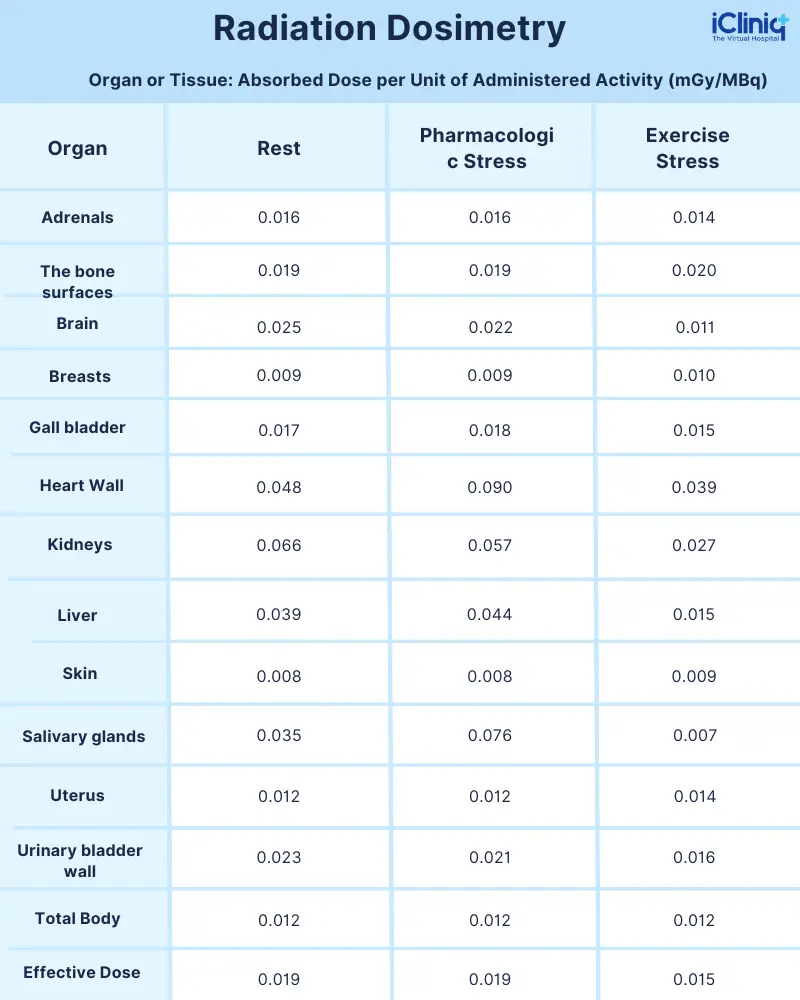
The maximum effective doses are 2.1 mSv (rest), 4.6 mSv (pharmacologic stress), and 5.3 mSv (exercise stress). A CT (computerized tomography) scan for attenuation correction will increase radiation exposure.
Warnings and Precautions
-
Risks Associated with Exercise or Pharmacologic Stress: Patients undergoing exercise or pharmacologic stress may face adverse severe reactions, including myocardial infarction, arrhythmia, hypotension, bronchoconstriction, stroke, and seizures. Stress testing should be conducted in environments with cardiac resuscitation equipment and trained personnel. When opting for pharmacologic stress instead of exercise, follow the prescribing information for the selected pharmacologic agent.
-
Radiation Risks: Flurpiridaz F 18 contributes to a patient’s cumulative long-term radiation exposure, which is linked to an increased risk of cancer. Safe handling practices are essential to minimize radiation exposure for patients and healthcare providers. Patients should be advised to stay hydrated before and after administration and to void frequently after the procedure.
What Are the Pharmacological Actions of Flurpiridaz F 18?
Mechanism of Action: Flurpiridaz F 18 is similar to pyridazine, a mitochondrial complex 1 (MC-1) inhibitor. It is absorbed by the heart based on blood flow and binds to active heart tissue, leading to higher radioactivity in healthy myocardium than in damaged tissue.
Pharmacodynamics: Clinical trials did not study the link between Flurpiridaz F 18 levels in the blood and successful imaging.
Pharmacokinetics: In healthy subjects, blood radioactivity peaked at 2.3 minutes after administration, then stabilized at about three percent of the dose for up to seven hours. In the first 15 minutes, the radioactivity was mainly from Flurpiridaz, shifting to its metabolites afterward.
-
Distribution: After 10 minutes, it was found mainly in the liver (19 percent), kidneys (nine percent), brain (eight percent), and heart (three percent).
-
Elimination: The drug is cleared from the blood within 48 hours.
-
Metabolism: It breaks down into various polar metabolites.
-
Excretion: After a dose, 63 percent of Flurpiridaz was found in urine (none unchanged) and 30 percent in feces (also unchanged).
Non-Clinical Toxicity:
Although it was not reported to cause cancer, this drug has also been tested in studies for its potential to have mutagenic activity. It was able to find evidence that showed this drug does not cause any genetic mutation. The said results were analyzed through different test procedures, such as the Ames test, a test for chromosome aberrations in Chinese hamster ovary cells, and a rat micronucleus test; all these proofs show that Flurpiridaz contains no mutagenicity potential.
What Are the Contraindications of Flurpiridaz F 18?
No contraindication documented clinically.
What Are the Drug Interactions of Flurpiridaz F 18?
There are no known significant drug interactions with Flurpiridaz F 18.
Clinical Studies
Two prospective randomized clinical studies in adults with suspected or known CAD or coronary artery disease investigated Flurpiridaz F 18's safety and efficacy.
Study 1: This study included 578 adults suspected of CAD. They were administered two injections of Flurpiridaz F 18, one at rest and the other at stress, either during exercise or pharmacologic stress. The aim was to determine the diagnostic information from Flurpiridazin about significant CAD using PET myocardial perfusion imaging versus invasive coronary angiography. The findings were that Flurpiridaz had good sensitivity and specificity in detecting significant stenosis, up to 89 percent sensitivity and 91 percent specificity, respectively.
Study 2: There were 755 adults with known or suspected CAD with ICA. As in Study 1, the study evaluated the diagnostic performance of Flurpiridaz at rest and during stress in subjects. The sensitivity ranged from 63 to 77 percent, and the specificity ranged from 66 to 86 percent for detecting significant CAD.
Both studies used images from rest and stress tests interpreted by blinded readers to determine whether ischemia or scar tissue was present. In general, Flurpiridaz performed well in identifying clinically significant CAD or coronary artery disease in the two populations.
Use in Specific Populations
Pregnancy
-
No data is available on the use of Flurpiridaz F 18 in pregnant women regarding birth defects, miscarriage, or other issues.
-
All radiopharmaceuticals, including Flurpiridaz F 18, can potentially harm the fetus depending on the development stage and radiation dose. Patients should be informed of risks when considering its use during pregnancy.
-
Flurpiridaz F 18 contains ethanol, which can harm the fetus, leading to central nervous system issues and developmental problems. Risks associated with ethanol should also be discussed.
-
Background risks of birth defects and miscarriage are estimated at two percent to four percent and 15 to 20 percent, respectively, in the general U.S. population.
Lactation
No human data regarding excretion into human milk is available. There are no published data on Flurpiridaz F 18 in breast milk or its effects on breastfeeding infants. To minimize exposure, lactating women should interrupt breastfeeding and express and discard milk for at least eight hours after administration.
Pediatric Use
The safety and effectiveness in pediatric patients have not been established for Flurpiridaz F 18.
Geriatric Use
From 1,600 patients participating in clinical studies, 720 (45 percent) were older than or at 65 years of age; 181 (11 percent) were older than or at 75 years of age. There was no apparent difference in safety and efficacy between geriatric versus younger patients.

