Table of Contents
- 1Key Categories and Trending Weight Loss Pills
- 2Food and Drug Administration Principles of Weight Loss Drugs
- 3FDA Approved Weight Loss Drugs
- 4Long-Term and Short-Term Weight Loss Drugs
- 5Novel Additions to Weight Loss Drugs
- 6Dosage Decisions: Suitable Weight Loss Drugs
- 7Weight Loss Drugs for Specific Conditions
Introduction
Weight loss drugs offer various approaches to help individuals tackle obesity and achieve a healthier body weight. These medications help reduce excess body fat, which is often linked to various health issues such as diabetes, heart disease, and hypertension. These drugs are categorized into various types, each with its own way of helping individuals shed those extra pounds. Each category of weight loss drugs employs a unique approach and is selected based on the individual’s requirements. Despite their differences, along with certain lifestyle changes, they play a significant role in helping individuals achieve their weight loss goals.
Therapeutic strategies like weight loss drugs offer prompt weight reduction, but innumerable medicaments are being sold across the globe under the name of “weight loss drugs.” However, not all of these drugs downgrade body weight through the same strategy. Each subset of weight loss drugs employs its own plan to remove extra pounds to maintain a body weight within the range cited as healthy and fit.
Key Categories and Trending Weight Loss Pills
Considering the working principle with which weight loss pills palliate the body weight, they could be categorized into the following subsets:
1. Appetite Suppressants:
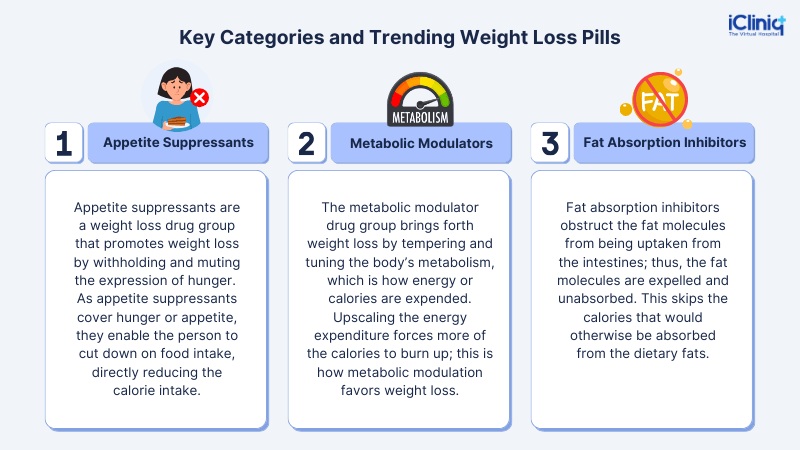
Ingesting more calories instigates weight gain, so the calorie intake should be compromised to downgrade body weight. Appetite suppressants are a weight loss drug group that promotes weight loss by withholding and muting the expression of hunger. As appetite suppressants cover hunger or appetite, they enable the person to cut down on food intake, directly reducing the calorie intake.
Appetite suppressants rely on the body’s chemical messengers and protein molecules to inflict gut fullness. Appetite suppression is instituted through hormones (ghrelin, insulin, cortisol, and leptin), GLP-1 (glucagon-like peptide 1—proteinaceous entity), and neurotransmitters (serotonin and gamma-aminobutyric acid).
Trending Drugs:
-
Phentermine: Phentermine interrupts and cuts off the brain’s hunger signals. Phentermine could be employed either alone or with other weight-loss drugs. Lomaira and Adipex-P are the brand names under which Phentermine is being marketed.
-
Lorcaserin: This medication inflicts gut fullness through its serotonin receptor agonism and thereby mitigates calorie intake. The routinely advocated formulation is in tablet form and is retailed as Belviq.
-
Liraglutide: This drug suppresses appetite by stimulating the activity of GLP-1. Saxenda is the marketed Liraglutide formulation meant for subcutaneous (formulation deposited underneath the skin) delivery.
-
Benzphetamine: It downturns hunger and thus expedites weight loss. Benzphetamine therapy should never be teamed with other drugs, not even with other weight loss medications. Regimex and Didrex are Benztamine’s in-demand brands.
2. Metabolic Modulators:
The metabolic modulator drug group brings forth weight loss by tempering and tuning the body’s metabolism, which is how energy or calories are expended. Upscaling the energy expenditure forces more of the calories to burn up; this is how metabolic modulation favors weight loss.
Trending Drugs:
-
Recombinant Leptin: Recombinant leptin works by upscaling the body’s metabolic process, which gears up energy expenditure. Therefore, more calories are exploited, which gravitates toward weight loss. Apart from being a metabolic enhancer, Recombinant leptin also invokes gut fullness by instigating appetite suppression.
3. Fat Absorption Inhibitors:
This particular weight loss drug group reveals its therapeutic implications by repressing the uptake and processing of dietary fats. Fat absorption inhibitors obstruct the fat molecules from being uptaken from the intestines; thus, the fat molecules are expelled and unabsorbed. This skips the calories that would otherwise be absorbed from the dietary fats.
Trending Drugs:
-
Orlistat: Orlistat disables and mutes the activities of the pancreatic and gastric lipases, which are implicated in fat breakdown and uptake. Under Orlistat's influence, around 25 percent of the dietary fats consumed will be stamped out as unabsorbed. Xenical and Alli are the brand denominations for the Orlistat formulation.
4. Thermogenic Agents:
Another potential weight loss drug class is the thermogenic agent, where weight loss is prompted by underscoring thermogenesis. It is through thermogenesis that the body maintains its normal temperature. However, it is achieved through the expense of calories. Thermogenic drugs gravitate toward calorie expenditure through thermogenesis. The calorie expenditure directly leverages the weight loss. Both thermogenic drugs and metabolic modulator drugs have overlapping attributes.
Trending Drugs:
-
Ephedrine: Ephedrine promotes weight loss by augmenting thermogenesis. Combining Ephedrine and caffeine deepens the thermogenic attributes and potentiates the efficacy of lowering body weight.
-
Sibutramine: Sibutramine also upregulates thermogenesis. In addition, it could also bring about appetite suppression.
Food and Drug Administration Principles of Weight Loss Drugs
The recent approvals of newer pharmacological options by the US (United States) Food and Drug Administration (FDA) mark a significant step forward in treating obesity. These weight loss medications have been developed more thoroughly, focusing on efficacy and safety. This cautious approach reflects a deeper understanding of the complexities of obesity, recognizing it as a chronic condition with a tendency for relapse.
By approving these drugs for long-term management, the FDA acknowledges the need for sustained intervention in combating obesity. This shift in perspective is crucial, as it underscores the importance of continuous support and treatment for individuals struggling with weight management. Furthermore, the availability of various weight loss pills provides healthcare providers with a broader range of options to tailor treatment plans according to individual patient needs. This personalized approach can enhance patient outcomes by addressing specific factors contributing to obesity and maximizing treatment effectiveness.
FDA Approved Weight Loss Drugs
Not all weight loss drugs are endorsed by the Food and Drug Administration. Below are the weight loss drugs that have gained marketing licensure from the FDA.
-
Phentermine-Topiramate.
-
Liraglutide.
-
Semaglutide.
-
Orlistat.
-
Setmelanotide.
-
Bupropion-Naltrexone.
FDA Recalled Weight Loss Drugs
Considering the safety profile, the FDA has withdrawn and called back a few of its approved weight-loss medications and suspended their marketing licensure.
-
Lorcaserin: Post-marketing assessment and analysis unmasked that Lorcaserin could gravitate toward certain cancers. Thus, Lorcaserin was eventually recalled and cleared from the market in 2020.
-
Sibutramine: Sibutramine therapy appreciably heightens cardiovascular disease prospects. As its beneficial attributes failed to offset the cardiovascular threat it could pose, the FDA withdrew it from the market in 2010.
-
Rimonabant: Post-marketing studies concerning Rimonabant underscored its gravity in bringing up psychiatric issues, particularly suicidal ideation. Therefore, the FDA called back Rimonabant’s marketing license in 2008.
-
Dexfenfluramine and Fenfluramine: The FDA called back two medicaments, Dexfenfluramine and Fenfluramine, owing to their potency in invoking cardiovascular issues, particularly heart valve impairments and hypertension (inflated blood pressure). The callback of Dexfenfluramine and Fenfluramine was initiated in 1997.
Long-Term and Short-Term Weight Loss Drugs
1. Appetite Suppressants That Are Advocated for Short-Term Weight Loss Therapy:
-
Adipex-P (pill).
-
Tenuate (pill).
-
Regimex (pill).
-
Pro-fast (pill)
-
Prelu-2 (pill).
-
Atti-plex P (pill).
Note: The above-quoted appetite suppressants are intended for short-term therapy owing to their inclination toward addiction.
2. Appetite Suppressants That Are Advocated for Long-Term Weight Loss Therapy:
-
Saxenda (injection formulation).
-
Wegovy (injection formulation).
-
Qsymia (pill).
-
Contrave (pill).
Long-Term Weight Loss Drug Use is essential for maintaining weight loss and preventing relapse. This approach recognizes obesity as a chronic condition needing sustained intervention.
Novel Additions to Weight Loss Drugs
In the evolving world of obesity management, the development of novel weight loss drugs offers promising solutions for people struggling with weight-related health issues. These latest drugs promise better results and fewer risks than traditional options, offering advanced and safer strategies for managing weight. However, with ongoing research, the future looks bright for efficient ways to tackle obesity and improve overall health.
A quick look at the novel additions to weight loss pharmacotherapeutics:
-
Zepbound: Zepbound is a novel addition to weight loss drugs, and it secured FDA (Food and Drug Administration) endorsement in November 2023. It is a Tirzepatide formulation, an apt choice for those with concurrent medical issues. It holds back hunger by decelerating the channeling of food across the stomach and intestine.
-
Maridebart Cafraglutide: Maridebart cafraglutide is another emerging candidate after completing phase 1 of the clinical trial. The outcomes from the phase 1 trial underscored that appreciable and enduring weight loss could be yielded through Maridebart cafraglutide. Due to its fewer-dosing frequency regimen, Maridebart cafraglutide's safety profile outweighs the hallmarks of other weight-loss drugs.
-
Gliprons: Gliprons are a discrete category of weight loss pills that survived the phase 3 clinical trial. Danuglipron and Orforglipron are the two medicaments in the Glipron subset currently under investigation and scrutiny to acquire a green signal from the FDA. The therapeutic attributes reflected by Gliprons are superlative and could bring a breakthrough in the weight loss journey.
Dosage Decisions: Suitable Weight Loss Drugs
The medical team frames the dosage of the weight loss drug to render maximum therapeutic outcomes with minimal safety threats.
1. Phentermine-Topiramate (Pill) -
Phentermine-Topiramate is advocated for teenagers (over 12 years) and adults.
-
Daily dose for the initial two weeks: 23 milligrams (mg) of Topiramate with 3.75 milligrams of Phentermine.
-
Daily for the subsequent 12 weeks: 46 mg Topiramate with 7.5 mg Phentermine.
-
Daily for the subsequent two weeks: 69 mg Topiramate with 11.25 mg Phentermine.
Following this, the drug dose might be upregulated considering the patient's response, provided it does not exceed the safer limit of 92 mg Topiramate with 15 mg Phentermine.
2. Liraglutide (Subcutaneous Injection) -
-
Initial daily dose: 0.6 mg for one week.
-
Dosage titration: The dose is upregulated weekly, capped at three milligrams.
3. Semaglutide (Subcutaneous Injection) -
-
Weekly dose (first week to fourth week): 0.25 milligrams.
-
Weekly dose (fifth to eighth week): 0.5 milligrams.
-
Weekly dose (ninth to 12th week): One milligram.
-
Weekly dose (13th to 16th week): 1.7 milligrams.
-
Weekly dose (maintenance phase from the 17th week): Ranges from 1.7 to 2.4 mg.
4. Orlistat (Pill) -
-
120 milligrams thrice daily.
-
Alongside fatty main course.
5. Setmelanotide (Subcutaneous Dose) -
Adult Dosing Schedule:
-
The daily dose for the first two weeks is two mg.
-
The daily during the maintenance phase: One to three mg.
Pediatric (Six to 12 Years) Dosing Schedule:
-
Daily dose for the first two weeks: Half the adult dose (one mg).
-
Daily dose during the maintenance phase: 0.5 to three mg.
Weight Loss Drugs for Specific Conditions
Certain weight loss drugs are safer even if one has other medical comorbidities. However, that does not imply the universal applicability of all weight loss drugs. Specific weight loss drugs are nominated for specific medical scenarios. Therefore, it is imperative to get medical advice before initiating any weight loss medicinal therapies to ascertain therapeutic efficacy with minimal safety considerations.
1. Weight Loss Drugs With Added Anti-diabetic Attributes:
-
Semaglutide: In addition to its potency as a weight loss drug, Semaglutide could augment insulin release and thus lower blood sugar levels.
-
Liraglutide: Liraglutide also appreciates insulin release, coupled with depreciation in glucagon release. Both these attributes palliate blood sugar proportions.
-
Orlistat: Orlistat reviews and upgrades the cell’s reception to insulin hormones, thus uplifting the effectiveness of insulin.
2. Weight Loss Drugs That Could Mitigate Hyperlipidemia (Elevated Cholesterol Proportion in Plasma):
Despite being a weight loss drug Orlistat can downscale cholesterol proportions in the blood by masking cholesterol absorption.
3. Weight Loss Drugs That Could Support Cardiovascular Health:
Semaglutide could upscale the cardiovascular profile by upholding the cardiovascular parameters. Blood pressure and vascular health projected commendatory outcomes with Semaglutide. Therefore, it is being designated as the hallmark weight loss drug choice for those with an appreciable inclination for cardiovascular complexities. The gravity and propensity for heart issues could be turned down by 20 percent with Semaglutide therapy, which was elaborated and underscored through clinical trials.
4. Weight Loss Drugs That Could Be Advocated in Chronic Kidney Disease Patients:
Orlistat could be considered a competent and appreciable weight loss drug choice for those with chronic kidney impairment. Fecal elimination of Orlistat downturns the inclination for the burden that weight loss drugs could otherwise impose on the kidneys. It is up to the doctor’s discretion whether to consider Orlistat or not, considering each patient’s health and well-being.
Conclusion
Obesity is a growing concern globally, but new drugs like Zepbound, Maridebart cafraglutide, and Gliprons offer promising ways to manage weight more effectively and safely. Each drug has specific dosages, works differently, and is designed to fit various health needs. Besides helping with weight loss, some of these drugs also improve blood sugar levels, lower cholesterol, and support heart health. However, it is essential to consult a healthcare professional to find the best and safest option to prevent side effects and to improve health and well-being.