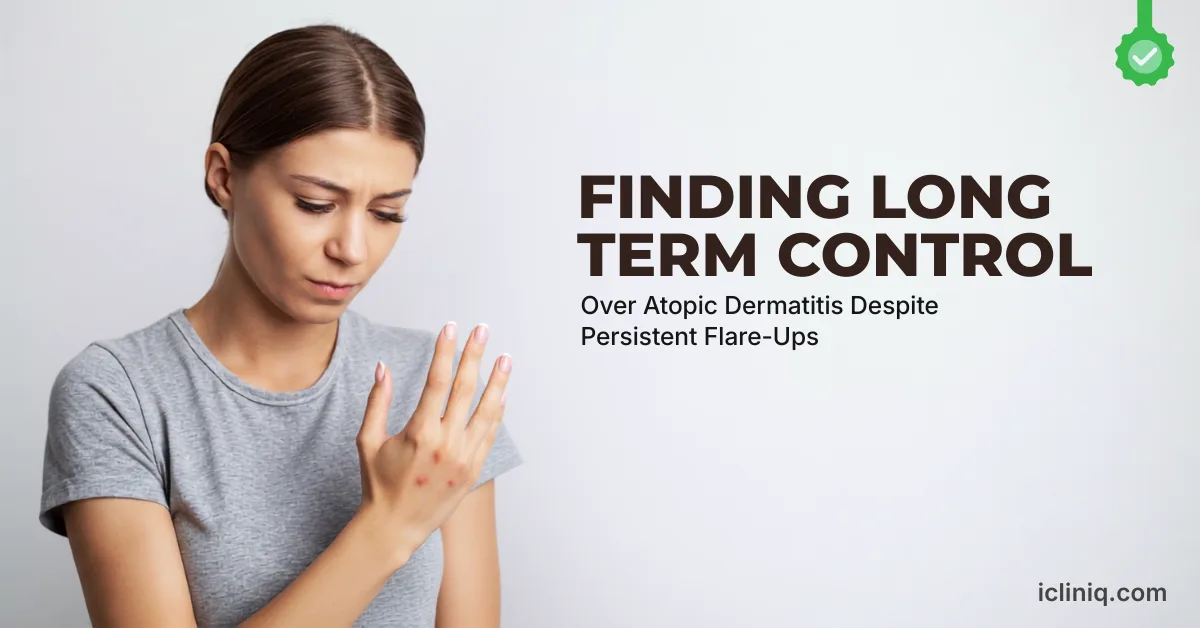
 Living with atopic dermatitis can be physically exhausting and emotionally overwhelming, especially when flare-ups continue despite following treatment. For one young adult, eczema had been a lifelong challenge. The condition mainly affected the folds of the skin and neck, causing persistent itching, inflammation, and discomfort that often interfered with daily life.
After years of using topical steroids and Tacrolimus ointment, the patient recently started Dupilumab injections, hoping to finally gain control over the disease. While the skin showed noticeable improvement, flare-ups still occurred, particularly during periods of emotional stress. Blood investigations also revealed elevated eosinophil counts and very high Immunoglobulin E (IgE) levels, leading to concerns that the treatment might not be working effectively. Questions about whether topical steroids should be stopped, whether food restrictions should continue, and how to prevent future flare-ups left the patient feeling uncertain.
Seeking expert guidance, the patient consulted iCliniq.
The consultation provided reassurance and a clear understanding of the recovery process. The iCliniq specialist explained that Dupilumab is one of the most effective treatments for moderate-to-severe atopic dermatitis, but its full benefits are usually seen after three to six months of consistent treatment. Experiencing flare-ups during the early months, particularly those triggered by stress or environmental allergens, is not uncommon and does not indicate treatment failure.
The doctor also clarified that high IgE and eosinophil levels are frequently seen in patients with severe atopic dermatitis and may remain elevated even after starting biologic therapy. Rather than discontinuing topical medications abruptly, the patient was advised to continue using topical corticosteroids during flare-ups and gradually taper them as the skin improved. For sensitive areas such as the face and neck, Tacrolimus ointment remained a suitable treatment option. Regular use of ceramide-based moisturizers was recommended to strengthen the skin barrier and reduce future flare-ups.
Another important concern involved food restrictions. The specialist explained that unless IgE-mediated food allergies had been confirmed, eliminating multiple foods unnecessarily was not recommended. Instead, foods could be reintroduced gradually under medical supervision. The patient also learned that stress management, adequate sleep, avoiding harsh soaps and detergents, wearing breathable clothing, and maintaining regular moisturization were equally important components of long-term eczema control.
Armed with a better understanding of the condition, the patient continued treatment with confidence instead of losing hope after the initial flare-ups. Over time, the skin became more stable, itching reduced significantly, and flare-ups became less frequent and easier to control.
This journey highlights that managing chronic atopic dermatitis requires patience, consistency, and expert guidance. Through iCliniq's evidence-based recommendations and personalized care, the patient learned that successful treatment is not about eliminating every flare immediately—it is about understanding the disease, following the right treatment plan, and achieving lasting control over time.
Doctors Online
2029
Fast and very detailed answer. Best part is wasting no time in assuring me that the issue is nothing to worry, which I greatly appreciate as I am an anxious person. Expertise + Empathy is rare these days.
A user from Philippines
Received answer in 13 minutes
Very prompt and thorough. Dr. Bukharia answered my question and was very patient with me. I will come back in the future!
A user from United States
Received answer in 27 minutes
OMG. So good. I can't belive it someone will answer my concern fast. Thank you so much Doc. May god bless you more. I will follow your advice. Thank you so much! Happy Client here.
A user from Philippines
Received answer in 1 hour 18 minutes
Thank you, the Dr was extremely helpful in understanding my condition and problem. He gave me great advice and well detailed explanations. He was very helpful and would highly recommend him.
A user from Pakistan
Received answer in 2 hour 7 minutes
Appreciate your quickest response Rajesh! He resolved my query in around 10 mins after I posted.
A user from India
Received answer in 12 minutes
Okay,I didn't expect my reply to come this soon but it did. And the doctor was kind of nice as though I was right in front of him. The overall experience was great, didn't find anything difficult.
A user from Nigeria
Received answer in 35 minutes
Thank you so so much! Really kind and answered the question perfectly. The reply was fast and the answer was detailed.
A user from Colombia
Received answer in 3 hour 49 minutes
Thank you so very much for your quick reply and clarifications. You cheered me up. :) I will look more into these solutions. Have a nice day! :)
A user from Romania
Received answer in 4 hour 43 minutes
She made me feel a lot better about it and gave me confidence to see my health care provider and get it properly treated.
A user from United States
Received answer in 7 minutes
A great site for medical advice....quick answer....accurate in consultation
A user from United Kingdom
Received answer in 3 hour 19 minutes
Very quick and detailed answer from a highly professional doctor. He answered my question very comprehensively!
A user from Croatia
Received answer in 2 hour 34 minutes
I am glad that he was able to understand the issue I was searching for. his advice is really helpful and I am like thank you so much.
A user from Romania
Received answer in 10 hour 28 minutes
Start your chat with a doctor for medical advice now.
