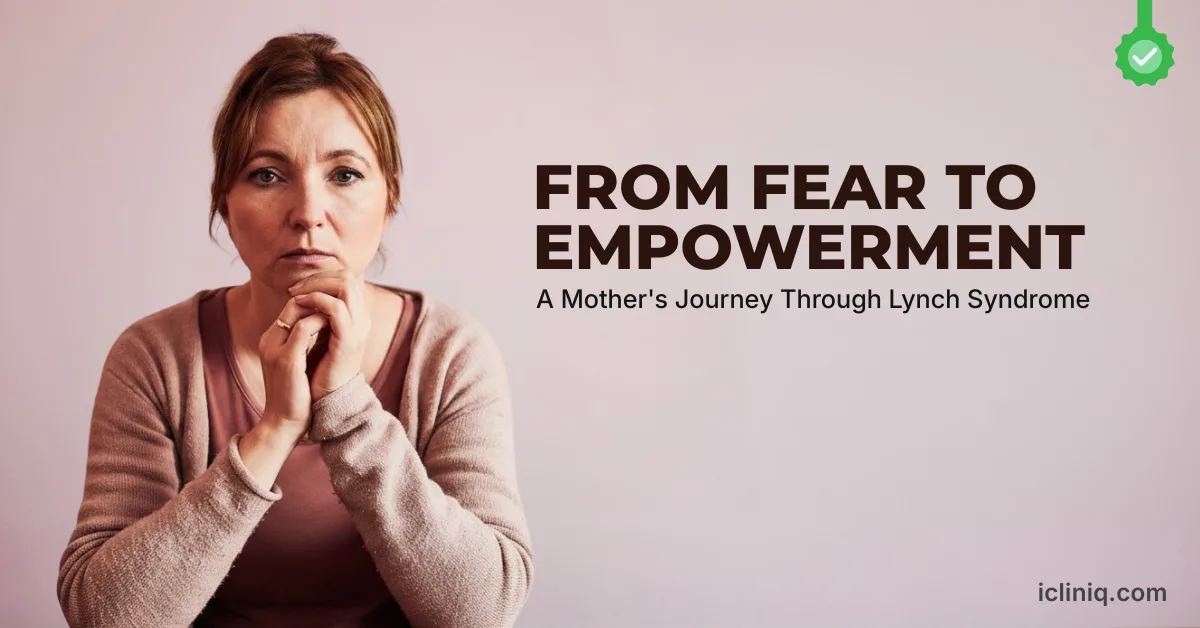
At 42, she never expected a cancer diagnosis. Endometrial cancer is far more common in women past menopause, yet there she was, navigating surgical consultations, treatment plans, and a medical vocabulary she had never imagined needing. The diagnosis alone was devastating. But what followed shook her even deeper.
Genetic testing, ordered by her oncologist to understand why cancer had struck so young, returned a result that changed everything: Lynch syndrome. A hereditary condition caused by mutations in DNA mismatch repair genes, Lynch syndrome dramatically elevates the risk of endometrial, colorectal, ovarian, and several other cancers. In an instant, her fear for herself became fear for her daughters, aged 16 and 19, and the possibility that she had unknowingly passed this mutation on to them.
Consumed by guilt and uncertainty, she turned to iCliniq and laid out three questions that had been keeping her awake at night: When should her daughters be tested? What would lifelong surveillance look like if they tested positive? And was there anything they could do right now to reduce their risk meaningfully?
The response she received did not just answer her questions; it gave her a framework for moving forward.
She learned that genetic counseling and testing are typically recommended once a child reaches adulthood, around 18 to 20 years of age. The older daughter, the doctor explained, was already at an appropriate age to begin that conversation with a genetic counselor. The younger one could wait a little longer, unless a specific medical reason arose to act sooner.
For a daughter who tests positive, the road ahead is one of consistent, proactive monitoring rather than passive worry. Regular colonoscopies beginning between ages 20 and 25, pelvic examinations, transvaginal ultrasounds, and periodic abdominal imaging form the backbone of surveillance. These are not burdens, she was reminded; they are tools that allow Lynch syndrome carriers to catch cancer early, when it is most treatable.
The guidance did not stop there. Lifestyle choices such as maintaining a healthy weight, staying physically active, eating a balanced diet, and avoiding tobacco use support overall health and may reduce cancer risk. Low-dose aspirin, under medical supervision, has shown promise in reducing colorectal cancer risk in high-risk individuals. And as the daughters grow older and complete their families, prophylactic surgical options can be discussed with their care teams.
Perhaps the most grounding piece of information was this: Lynch syndrome follows an autosomal dominant pattern, meaning each daughter has roughly a 50 percent chance of having inherited the mutation. There is an equally real chance that neither carries it.
She came to iCliniq overwhelmed. She left with a plan for herself, and for the daughters she was determined to protect.
Doctors Online
2029
Fast and very detailed answer. Best part is wasting no time in assuring me that the issue is nothing to worry, which I greatly appreciate as I am an anxious person. Expertise + Empathy is rare these days.
A user from Philippines
Received answer in 13 minutes
Very prompt and thorough. Dr. Bukharia answered my question and was very patient with me. I will come back in the future!
A user from United States
Received answer in 27 minutes
OMG. So good. I can't belive it someone will answer my concern fast. Thank you so much Doc. May god bless you more. I will follow your advice. Thank you so much! Happy Client here.
A user from Philippines
Received answer in 1 hour 18 minutes
Thank you, the Dr was extremely helpful in understanding my condition and problem. He gave me great advice and well detailed explanations. He was very helpful and would highly recommend him.
A user from Pakistan
Received answer in 2 hour 7 minutes
Appreciate your quickest response Rajesh! He resolved my query in around 10 mins after I posted.
A user from India
Received answer in 12 minutes
Okay,I didn't expect my reply to come this soon but it did. And the doctor was kind of nice as though I was right in front of him. The overall experience was great, didn't find anything difficult.
A user from Nigeria
Received answer in 35 minutes
Thank you so so much! Really kind and answered the question perfectly. The reply was fast and the answer was detailed.
A user from Colombia
Received answer in 3 hour 49 minutes
Thank you so very much for your quick reply and clarifications. You cheered me up. :) I will look more into these solutions. Have a nice day! :)
A user from Romania
Received answer in 4 hour 43 minutes
She made me feel a lot better about it and gave me confidence to see my health care provider and get it properly treated.
A user from United States
Received answer in 7 minutes
A great site for medical advice....quick answer....accurate in consultation
A user from United Kingdom
Received answer in 3 hour 19 minutes
Very quick and detailed answer from a highly professional doctor. He answered my question very comprehensively!
A user from Croatia
Received answer in 2 hour 34 minutes
I am glad that he was able to understand the issue I was searching for. his advice is really helpful and I am like thank you so much.
A user from Romania
Received answer in 10 hour 28 minutes
Start your chat with a doctor for medical advice now.
