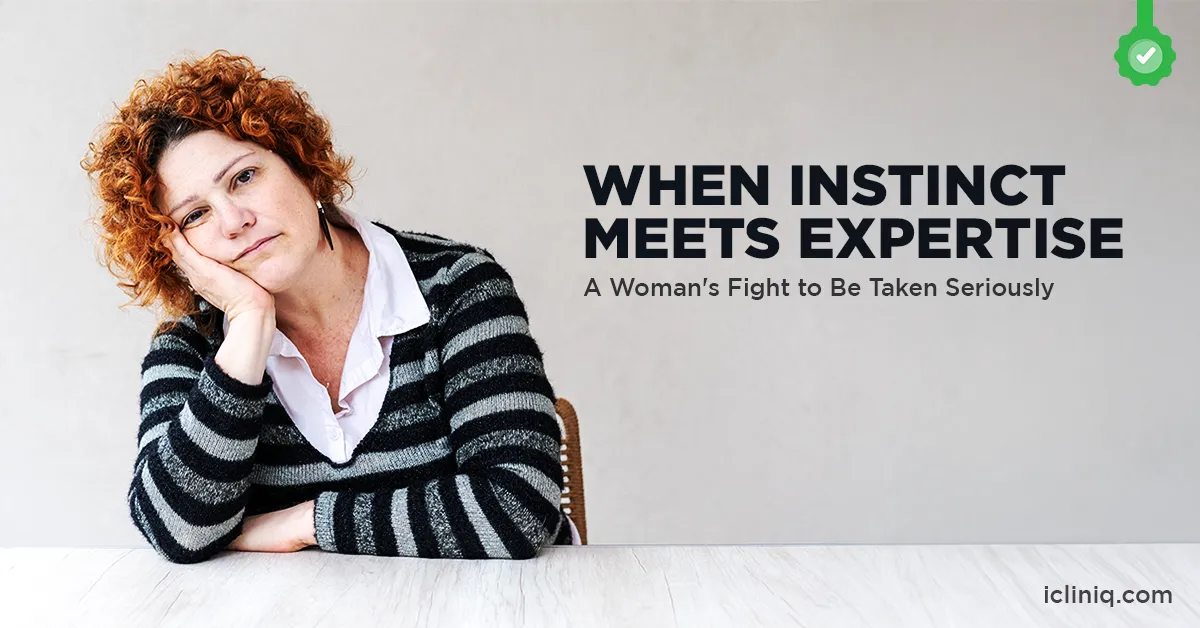
 For seven months, she had been trying to tell her doctors that something was wrong. Not mildly wrong, seriously wrong. On her heaviest days, she was soaking through a super tampon every 45 to 60 minutes, passing large clots, and feeling the slow drain of a body running low on resources. Her hemoglobin had fallen to 8.8 g/dL. Her ferritin had dropped to just 4 ng/mL. Iron supplements were keeping her afloat, but only barely.Her general physician’s response was consistent: it was probably stress. Track your cycles. At 36, she was too young to worry. But she had context her general physician seemed unwilling to weigh. Her mother had been diagnosed with endometrial cancer at 42. Two years earlier, genetic testing had confirmed that she herself carried Lynch syndrome, a hereditary condition that significantly raises the risk of endometrial, colorectal, and other cancers. Her gynecologist had prescribed Norethisterone to manage the bleeding, but had not investigated its cause. No imaging. No biopsy. No referral.She was not looking for panic. She was looking for answers. And so she turned to iCliniq with two direct questions: was she overreacting by pushing for a pelvic ultrasound, and what investigations were actually appropriate for someone with her risk profile?
The answer she received was immediate and unambiguous: no, she was not overreacting. Not even close.
The doctor on iCliniq confirmed that heavy bleeding at her age, particularly in the context of Lynch syndrome and a family history of early-onset endometrial cancer, absolutely warranted thorough investigation. The cause could be benign, fibroids, adenomyosis, or hormonal fluctuations, but it could also be something more serious, and the only way to know was to look.
The recommended path forward was clear. A clinical examination followed by a transvaginal ultrasound would be the starting point, checking for structural causes and any thickening of the endometrium. If the ultrasound raised concerns, a diagnostic hysteroscopy and endometrial biopsy would be the next step, the most reliable way to evaluate the uterine lining directly. Only once a structural or pathological cause had been ruled out should hormonal management alone be considered.
She was also advised to document her bleeding carefully; the number of tampons used, frequency, and clot size to give her gynecologist an objective picture rather than relying on a general description. What she took away from the consultation was more than a list of tests. It was validation. Her instinct to push back, to ask harder questions, and to refuse a dismissal that did not account for her full medical picture was not just reasonable; it was right.
Sometimes, the most important thing a patient can do is refuse to be told they are too young to worry.
Doctors Online
2029
Fast and very detailed answer. Best part is wasting no time in assuring me that the issue is nothing to worry, which I greatly appreciate as I am an anxious person. Expertise + Empathy is rare these days.
A user from Philippines
Received answer in 13 minutes
Very prompt and thorough. Dr. Bukharia answered my question and was very patient with me. I will come back in the future!
A user from United States
Received answer in 27 minutes
OMG. So good. I can't belive it someone will answer my concern fast. Thank you so much Doc. May god bless you more. I will follow your advice. Thank you so much! Happy Client here.
A user from Philippines
Received answer in 1 hour 18 minutes
Thank you, the Dr was extremely helpful in understanding my condition and problem. He gave me great advice and well detailed explanations. He was very helpful and would highly recommend him.
A user from Pakistan
Received answer in 2 hour 7 minutes
Appreciate your quickest response Rajesh! He resolved my query in around 10 mins after I posted.
A user from India
Received answer in 12 minutes
Okay,I didn't expect my reply to come this soon but it did. And the doctor was kind of nice as though I was right in front of him. The overall experience was great, didn't find anything difficult.
A user from Nigeria
Received answer in 35 minutes
Thank you so so much! Really kind and answered the question perfectly. The reply was fast and the answer was detailed.
A user from Colombia
Received answer in 3 hour 49 minutes
Thank you so very much for your quick reply and clarifications. You cheered me up. :) I will look more into these solutions. Have a nice day! :)
A user from Romania
Received answer in 4 hour 43 minutes
She made me feel a lot better about it and gave me confidence to see my health care provider and get it properly treated.
A user from United States
Received answer in 7 minutes
A great site for medical advice....quick answer....accurate in consultation
A user from United Kingdom
Received answer in 3 hour 19 minutes
Very quick and detailed answer from a highly professional doctor. He answered my question very comprehensively!
A user from Croatia
Received answer in 2 hour 34 minutes
I am glad that he was able to understand the issue I was searching for. his advice is really helpful and I am like thank you so much.
A user from Romania
Received answer in 10 hour 28 minutes
Start your chat with a doctor for medical advice now.
