- 1What Is Sertraline Used For?
- 2How Does Sertraline Work?
- 3What Is the Dosage of Sertraline?
- 4How to Use Sertraline?
- 5What Are the Drug Warnings and Precautions?
- 6What Are the Side Effects of Sertraline?
- 7What Should I Know Before Taking Sertraline?
- 8What Are the Interactions of Sertraline?
- 9Key takeaway from iCliniq
Drug Group:
Sertraline belongs to the group of drugs called selective serotonin reuptake inhibitors (SSRIs). The other drugs belonging to this group are Fluoxetine, Fluvoxamine, Citalopram, Escitalopram, and Paroxetine.
What Is Sertraline Used For?
-
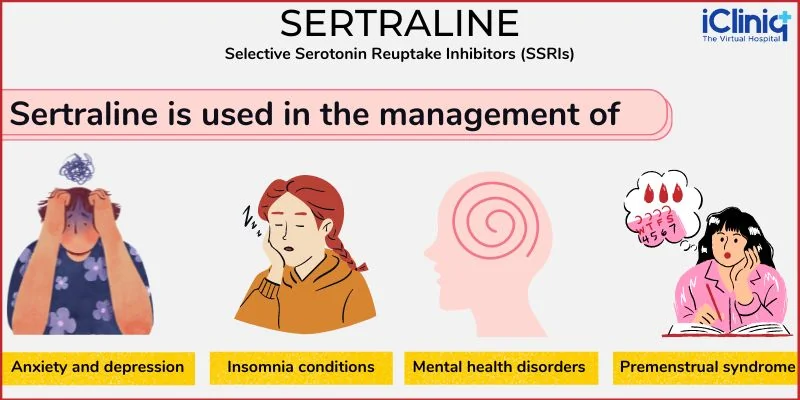
They are the most preferred drugs for anxiety disorders.
-
It is used for severe cases of premenstrual syndrome and premenstrual dysphoric disorder.
-
It is used to overcome many mental health disorders, such as obsessive-compulsive disorder, post-traumatic stress disorder, social anxiety disorder, depression, and panic attacks.
-
It improves sleeping patterns and helps with insomnia.
How Does Sertraline Work?
Sertraline works by increasing a special chemical called serotonin in the brain. Serotonin is known to be a hormone that gives happiness. Generally, serotonin is easily reabsorbed.
However, these selective serotonin reuptake inhibitors cause serotonin to remain in the neurons for a longer period of time, which is why Sertraline has a prolonged duration of action. The absorption of Sertraline may be improved when taken with food.
Depression occurs when there is an imbalance in the levels of serotonin, so Sertraline is prescribed for conditions involving depression and mood disorders.
Onset of action:
While it typically takes 4 to 6 weeks to work completely, some individuals may begin to feel better as early as 1 to 2 weeks. Some people require a prolonged duration for the drug to show its effects. The time required for Sertraline to start its action varies from patient to patient. The dosage needs to be changed based on the patient’s response to the medicine after seven days.
Habit-forming:
This drug is known to be addictive in some patients. Generally, all antidepressants are known to be habit-forming.
What Is the Dosage of Sertraline?
The dosage of Sertraline will be decided by your doctor based on your age, weight, and other medical conditions. You will first be started on a low dosage, and depending on how your body reacts, the dosage will be modified. Sertraline is available from 10 mg to 200 mg strength.
Sertraline dosage for adults:

Sertraline dosage for children:

How to Use Sertraline?
Always take your medicine exactly as your doctor tells you. But here are a few general guidelines to follow while taking Sertraline:
-
Take Sertraline tablets along with water.
-
This medication can be taken with or without food. However, if it causes stomach discomfort, it's best to take it with food.
-
Take it at the same time each day, morning or evening. If it makes it hard to sleep, take it in the morning.
-
Your pharmacist might give you a guide. Make sure you read it carefully.
-
If you miss a dose, take it as soon as you remember. Don’t take two at once.
-
Only take what your doctor says. If you take too much, call the poison center right away.
-
Keep taking it until your doctor tells you to stop.
-
This medicine is only for you. Don’t share it with anyone else.
-
If you have the liquid medicine, mix it in a drink before taking it.
Missed dose:
If you miss a dose, your medication might stop working very abruptly. It is highly recommended not to miss a dose. If you happen to miss it, do not take excessive doses at a time. Taking a small extra dose can be very dangerous. The negative aspects of missing these doses are:
-
Headache.
-
Restlessness.
-
Confusion.
-
Tremors.
Overdose:
If someone takes an overdose of Sertraline, it can be dangerous. Get medical help right away or call the poison control helpline. Symptoms of overdose are:
-
Dizziness.
-
Drowsiness.
-
Hallucinations.
-
Confusion.
-
Sweating.
-
Shivering.
-
Fast heartbeat.
-
Loss of coordination.
-
Nausea.
-
Vomiting.
-
Agitation.
-
Mania.
-
Seizures.
-
Severe muscle stiffness.
How Should I Store Sertraline?
Sertraline can be kept at room temperature, between 68 degrees Fahrenheit (20 degrees Celsius) and 77 degrees Fahrenheit (25 degrees Celsius). It’s okay if it gets a little warmer or cooler, between 59 degrees Fahrenheit (15 degrees Celsius) and 86 degrees Fahrenheit (30 degrees Celsius), but only for a short time, like when you’re traveling. It should be stored in a cool, dry place.
What Are the Drug Warnings and Precautions?
When you are taking Sertraline, you should avoid taking a few other drugs. This is because both are known to interact with each other and cause many side effects. Inform the doctor if you have any of these conditions:
-
Pregnancy: Some doctors prescribe Sertraline during the first trimester of pregnancy. However, it can cause some serious problems like breathing problems, premature birth, and maternal weight loss. You should get advice from your doctor.
-
Breastfeeding: The drug Sertraline does not enter the baby much through the breastmilk. But considering the antidepressant effect, take these medicines if you have postpartum depression as per your doctor’s advice.
-
Suicidal thoughts: Sertraline can increase the state of depression. If you experience any suicidal thoughts, consult a doctor immediately.
-
Diabetes: Sertraline can affect blood sugar levels. So it is important to see a doctor before using it.
-
Arrhythmia: Sertraline can affect the heartbeat (it can make it fast or irregular). Consult the doctor before taking it.
-
Weight loss: Sertraline has caused weight loss in some patients. It is necessary to check with your doctor or dietitian regarding your diet.
-
Seizures: Some patients are reported to get seizures. Patients with epilepsy should ask their doctor for advice before taking these drugs.
-
Abnormal bleeding: This drug is known to cause unnecessary bleeding in patients who are taking Aspirin and Warfarin.
-
Driving or operating heavy machinery: Sertraline can cause dizziness and disturbances in vision. It is not advised for patients to drive or operate any other heavy machinery. The alertness of mind is required while doing these activities.
-
Kidney problems: Sertraline can cause serious side effects in patients with kidney problems.
-
Liver diseases: Correct antidepressants should be chosen for patients with liver disease. It is necessary to get recommendations from your doctor.
-
Serotonin syndrome: Linezolid also increases the possibility of getting serotonin syndrome (a dangerous condition where there is too much serotonin buildup in the brain). Drugs such as Isocarboxazid, Tranylcypromine, and Phenelzine, belonging to the group of monoamine oxidase inhibitors, are known to cause serotonin syndrome in patients.
What Are the Side Effects of Sertraline?
The common side effects seen in Sertraline are:
-
Tremors.
-
Sexual problems, including decreased sex drive and failure of ejaculation.
-
Nausea.
-
Loss of appetite.
-
Diarrhea and indigestion.
-
Altered sleeping habits.
-
Increased sleepiness and insomnia.
-
More frequent urination and urine leakage.
-
Tiredness.
-
Nose bleeds.
-
Heavy menstrual bleeding.
-
Headache.
-
Dry mouth.
The above-mentioned symptoms are usually mild. They might disappear in a few days. If it prolongs for many days, you should consult your doctor immediately.

The most severe symptoms are:
-
Impulsive and risk-taking behaviors.
-
Aggressive or violent behaviors.
-
Hallucinations and delusions.
-
Suicidal thoughts and attempts.
-
Worse depression
-
Anxiety or panic attacks
-
Agitation and anger.
-
Stiff muscles.
-
Loss of consciousness.
-
Eye pain.
-
Seizures and coma.
-
Swelling or redness in the eye.
-
Increase in heart rate.
-
Altered blood pressure.
-
An altered vision, such as blurred vision and double vision.
-
Blood while coughing.
-
Bleeding from the gums.
-
Changes in the periods.
-
Weight gain or weight loss.
-
Liver problems (skin turns yellow).
-
Change in sex drive.
-
Painful erections that last for more than 2 hours.
Allergic reactions:
-
Rashes and blisters.
-
Breathing difficulties.
-
Swelling of your face, mouth, tongue, and eyes.
-
Abnormal bleeding.
-
Struggling to swallow.
Mania:
-
Reckless behavior.
-
Abnormally excessive energy.
-
Talking faster than usual.
-
Excessive happiness or irritated feeling.
What Should I Know Before Taking Sertraline?
A few things that you should know before taking Sertraline are:
-
Sertraline is a medicine doctors give to help with depression and other mental health issues.
-
Tell your doctor before starting Sertraline if you have any health problems like seizures, bipolar disorder, high blood pressure, thyroid disease, liver or kidney problems, heart issues, bleeding troubles, glaucoma, or allergies to medicines.
-
Sertraline can have common side effects that are mild and usually go away soon. But if you feel very sick, you need to see a doctor right away.
-
Tell your doctor if you are taking other medicines, herbal remedies, or vitamins.
-
This medicine is only given with a doctor’s prescription. Don’t start or stop taking it without talking to your doctor. Stopping suddenly can make you feel unwell.
-
Sertraline can take about 4 to 6 weeks before you feel its full effects, so you need to be patient.
-
Because it can make you sleepy or dizzy, you shouldn’t drive or use heavy machines.
-
Avoid drinking alcohol, and always tell your doctor if you are pregnant or breastfeeding.
What Are the Interactions of Sertraline?
It is common for all drugs to interact with other drugs, food, and supplements. This interaction can result in certain unwanted side effects. The common interactions of Sertraline are:
With medicine:
-
Non-steroidal anti-inflammatory drugs (NSAIDs).
-
Linezolid.
-
Cimetidine.
-
Pimozide.
-
Fentanyl.
-
Tramadol.
-
Amitriptyline.
-
Desipramine.
-
Imipramine.
-
Dronedarone.
-
Monoamine oxidase inhibitors.
-
Methylene blue.
-
Thioridazine.
-
Amphetamines.
-
Medications that treat fungal infections, like Ketoconazole.
-
Flecainide.
-
Almotriptan.
-
Phenytoin.
-
Warfarin.
-
Digoxin.
-
Safinamide.
-
Tolbutamide.
With disease:
-
Liver diseases.
-
Seizures.
-
Serotonin syndrome.
With alcohol:
-
Sertraline, along with alcohol consumption, can be very harmful. It might cause a loss of clarity in thoughts and make the person stay in a confused state all the time.
With herbal remedies:
-
St John's wort (Hypericum perforatum).
Conclusion
So, Sertraline is a medicine that helps people feel happier and calmer by increasing serotonin, a chemical in the brain. But before taking it, it’s very important to tell the doctor about any health problems you have and any other medicines or herbs you use. This helps the doctor decide if Sertraline is safe for you because it can mix with other medicines. Always ask your doctor first; they’re there to keep you safe!
Key takeaway from iCliniq
-
Sertraline is an antidepressant that is used to treat many mental health disorders. It works by increasing a special chemical in the brain called serotonin, which helps us feel happier and calmer.
-
Sertraline can start helping you feel better after 1 or 2 weeks, but sometimes it takes 4 to 6 weeks to feel all better.
If you ever feel sad or worried, our iCliniq psychiatrist can help you and talk to you about your feelings. You are not alone, and asking for help is always okay.